
Do You Really Need an AI Agent For That? The Right (Not Rushed) Approach to Agentic AI

As agentic AI becomes a hallmark of every enterprise roadmap, many organisations are racing to build agents – before defining the problems they’re meant to solve. But without clear outcomes, governance and integration, agentic AI becomes an expensive experiment, not a strategic investment.
Right now feels a bit reminiscent of Apple’s “There’s an app for that” campaign of the early 00s, with technology vendors publishing thousands of AI agents promising to make life easier. There’s an AI agent for that!
However, Google’s DORA research group in their latest AI Capability Model report use an analogy I love: AI is an amplifier. It amplifies the strengths of your processes, your platforms and your organisational data.
It also amplifies the gaps.
Hence, the rush to use the latest AI developments is a top reason why organisations end up with epic AI fails.
Instead, enterprises must slow down, evaluate where AI can genuinely create value, and then design agents that elevate existing enterprise and operational systems.
Drawing upon our experiences at Telefónica Tech, here’s the right way to approach building AI agents.
The Current Situation
Agentic AI is everywhere, from analyst reports to vendor roadmaps to keynote stages. All are filled with promises of autonomous enterprise operations.
In fact, we recently hosted an AI Buzzword Bingo event, and one of the top voted for buzzwords? You guessed it: agentic AI.
Many organisations feel pressurised to adopt AI agents quickly just to keep up with the competition.
But here is the reality:
- Most AI agents today are proof-of-concepts, not deployed production systems
- Many enterprises lack clear governance framework for autonomous decision-making
- AI agents often run separately from core business systems, limiting their usefulness
- Operational teams struggle to trust and measure agentic AI behaviours
Bain’s 2025 Technology Report provides important nuance: while AI investment is up, returns often lag expectations. Many early ambitions, such as of 30-50% efficiency improvements, have not materialised due to orchestration gaps.
As a result, a flurry of AI initiatives that look impressive on paper – or in this case, in demos – but do very little to move the needle on operational efficiency or customer experience.
Start With the Business Problem, Not the Technology
In a market saturated with emerging AI capabilities, the organisations that realise meaningful impact from agentic AI are those that adopt a scenario-first, outcome-led approach.
At Telefónica Tech, when we start working with a new customer, we always start the conversation by asking “What’s keeping you up at night?”
For example, you wouldn’t implement a new CRM or ERP system without first understanding the issues it needs to solve. The same goes for AI envisioning: start with the business problem.
This approach helps us to focus on the critical moments that shape customer experience, operational efficiency, and employee productivity.
This means identifying:
- High-friction processes that delay service delivery or decision-making
- Manual and/or repetitive tasks that consume expert time
- Areas where customer expectations are evolving faster than current capabilities
- Operational or compliance processes with high variation or inconsistency
These pressure points reveal where autonomous reasoning and action can generate measurable improvements.
Identifying High-Value Agentic AI Scenarios
Not every process or scenario needs an agent to make it better. In fact, many do not.
So, the first step is assessing whether an agent is the right solution at all.
Once we have identified that agentic AI is the way to solve our problem, we need to do a deep dive on Value and on Feasibility.
What we’re looking for is the sweet spot: where high value meets high feasability.
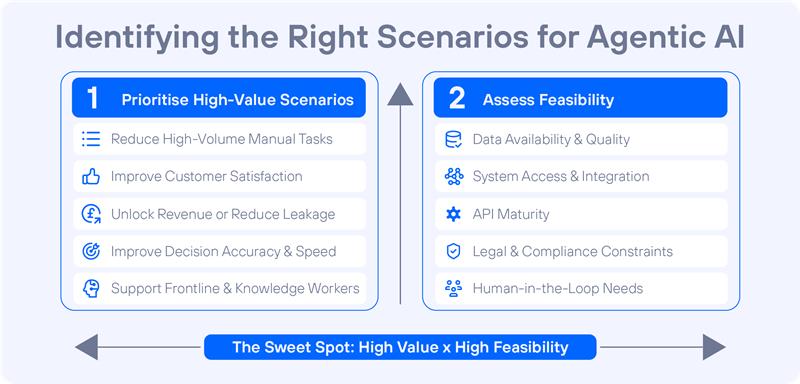
Value – Which scenarios drive the most measurable impact?
The strongest agentic AI use cases enhance the moments in your operations where intelligence, context and multi‑step action can materially improve outcomes.
Prioritise scenarios that:
- Reduce high-volume of manual tasks
- Improve customer satisfaction by faster response
- Unlock new revenue opportunities
- Improve decision accuracy or response time
- Support frontline workers or knowledge workers at scale
Feasibility – Can the agent work with your current environment?
Consider:
- Data quality and availability
- Access to systems
- API maturity
- Legal, risk and compliance constraints
- Human-in-the-loop requirements
For each of the above identified scenarios, measure value with the right Key Performance Indicators (KPIs). Tie each use-case to a small set of relevant metrics:
- Efficiency: time saved, process cycle time, error rate
- Customer: Net Promoter Score, customer satisfaction score, case resolution time and conversion lift
- Finance: cost per transaction, revenue uplift, margin impact
- Risk and compliance: incident rate, audit findings, policy adherence
Often, the most impactful AI scenarios are not net-new ones, they emerge by augmenting existing CRM, ERP, HR, ITSM or case management processes with reasoning and autonomy.
Integrating AI agents with existing systems is key
A study done by UiPath notes that lack of interoperability is the second most cited reason for pilot failures, right after data quality issues. In fact, 87% of IT leaders rate interoperability as either “very important” or “crucial” to the successful adoption of agentic AI.
In other words, agentic AI becomes exponentially more valuable when it connects directly into the systems your organisation already relies on.
One of the strongest advantages of agentic AI is that it does not require enterprises to rebuild their technology landscape. Instead, it extends and augments the existing CRM, ERP, ITSM and other line‑of‑business systems that organisations already use.
The real magic happens when autonomous reasoning and multi-step actions are layered on top of the platforms that hold your processes, data and operational workflows.
Below are some of the ways through which Agentic AI integrates seamlessly into enterprise environments.
- Power Platform Connectors – providing structured access to enterprise systems, such as a Copilot Studio AI agent that automates lead qualification in Dynamics 365 Sales
- Model Context Protocol – for a modern, governed approach to giving AI agents secure tool access
- Third Party Agents – orchestrating collaboration between agents such as in Microsoft 365 Copilot and ServiceNow
This keeps each platform doing what it does best and avoids duplicating logic, data models, and governance controls.
Without these integrations, the agent is limited to advice rather than execution. Integrations are the bridge from conversational intent to system-of-record action.
Prioritising clarity over speed
So, despite living in a world of “There’s an AI agent for that!”, the winners in the next wave of enterprise transformation will not be the companies that deploy the most AI agents first.
They will be the ones that deploy them wisely. The ones that prioritise clarity over speed, intentional design over hype-driven experimentation and integration over isolation.
Agentic AI has extraordinary potential but only when aligned with real business needs, grounded in strong governance and built to enhance the systems that already run your organisation.
For help with agentic AI, get in touch with Telefónica Tech – we help organisations determine the best way forward towards efficient, modern business processes.
Take a methodical approach to agentic AI. Learn more about our Prism framework →