
Is The Leapfrog Problem Holding Back Your AI Transformation?


Throughout history organisations that have successfully adapted to one technological revolution have often found themselves less prepared for the next. The systems, processes and ways of working that once drove success can become barriers to future transformation.
We are now seeing the same pattern with AI.
Take the telecommunications industry as an example. In the UK, full fibre broadband was available to 78% of premises by July 2025, yet around 14 million homes still remained connected through legacy copper-based lines so were unable to take advantage of the new tech. The challenge wasn’t a lack of technology. It was the complexity of replacing infrastructure that had once been a major success.
This is what we call the Leapfrog Problem.
When success becomes a barrier to change
Most organisations have spent years refining processes, investing in technology and building operating models that deliver reliable outcomes.
Of course, these are often the foundations of business success.
However, every major technology shift creates a challenge: the more invested an organisation is in its current way of working, the harder it can be to imagine a different one.
This is the essence of the Leapfrog Problem: where laggards are actually able to move forward faster, due to having less to deconstruct.
Success creates systems, processes and behaviours that are optimised for today’s challenges, but those same strengths can become barriers when new technologies emerge.
The result is that organisations often focus on improving existing processes rather than rethinking them altogether.
What can you do about it? Change the question.
Thus, a key part of our customer workshops at Telefónica Tech is examining business processes, exposing assumptions, and challenging the desire to jump to AI automation.

AI is exposing old assumptions
Because of the Leapfrog Problem, many organisations are approaching AI by asking:
“How can we automate this process?”
While automation can undoubtedly drive efficiencies, this question can limit the value AI is capable of delivering. It can also lead to rushed AI adoption in the current era of “there’s an agent for that!”.
A more powerful question is:
“Should this process exist in its current form at all?”
Reviewing outdated workflows and rethinking how work is designed, delivered and managed are all great benefits of AI.
By asking the former, this is where many transformation programmes encounter resistance.
AI can generate content, analyse information, automate decisions and support employees in entirely new ways – but layering these capabilities on top of processes designed for a different era often results in a small improvement rather than meaningful transformation.
Instead, to unlock real value, organisations need to challenge assumptions, redesign workflows and rethink established operating models.
It can mean more work in the short term but leads to exponential returns.
Why governance matters as much as technology
One of the biggest misconceptions surrounding AI adoption is that success depends primarily on selecting the right tools.
In reality, successful AI programmes require much more than technology, such as:
- Governance
- Risk management
- Adoption strategies
- Skills development
- Organisational readiness
For example, Estonia’s digital transformation has been built on more than technology alone. Today, around 99% of government services are available online, supported by digital identity, interoperability and citizen trust. Around 95% of citizens trust the government with their data, demonstrating the importance of governance alongside innovation.
For organisations investing in AI, the lesson is clear: technology can accelerate transformation, but sustainable success depends on having the right governance, processes and people in place to support it.
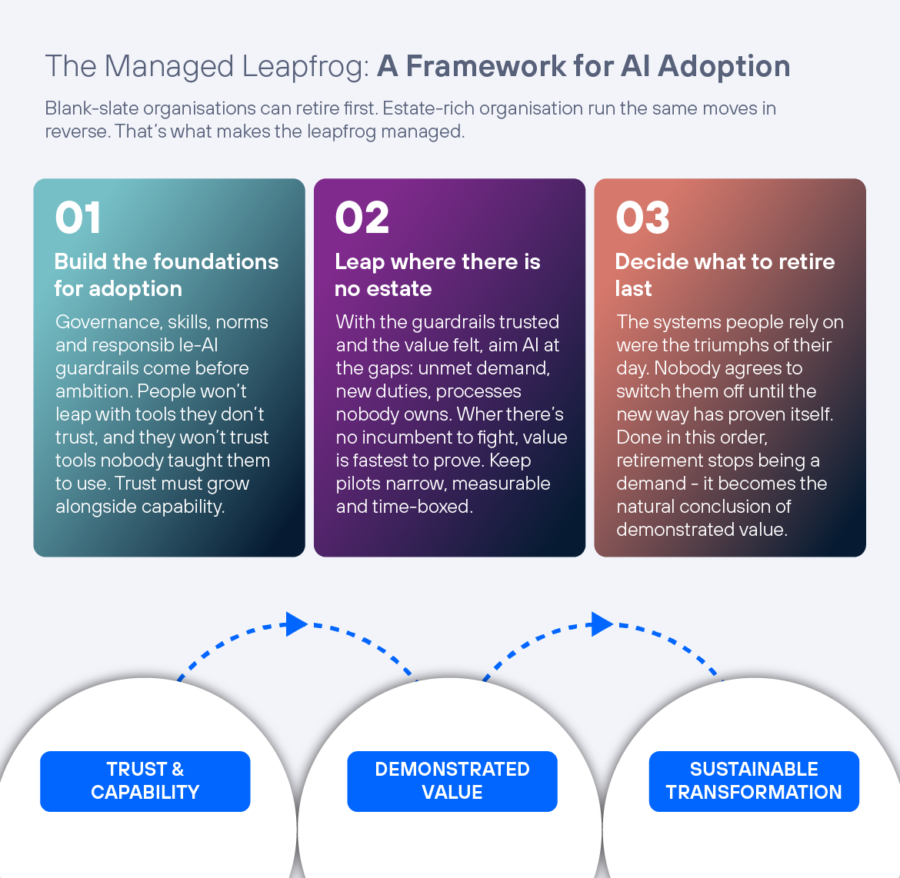
Three signs your organisation is ready to leap forward with AI
You’ll know you’re ready to take the AI leap when:
- You’re building governance before scale
- You’re focusing on high-value opportunities
- You’re willing to retire outdated ways of working
Businesses that successfully scale AI understand that transformation requires more than technology.
By building strong governance foundations, prioritising high-value use cases and retiring outdated ways of working, they create the conditions needed to move beyond experimentation and deliver lasting business value.
Looking beyond the technology
Through Telefónica Tech’s work helping organisations adopt AI, we’ve found that the biggest challenges often emerge long before deployment.
Questions around governance, operating models, user adoption and change management frequently require as much attention as the technology itself.
This is why AI transformation should not be viewed as a technology project.
It’s a business transformation programme that happens to be enabled by technology!
The opportunity ahead
My advice is that organisations that gain the greatest value from AI will be those willing to:
- Move beyond legacy thinking
- Modernise outdated processes
- Redesign how work is delivered
The Leapfrog Problem reminds us that yesterday’s success can sometimes make tomorrow’s transformation harder.
But organisations that recognise this challenge and address it proactively are better positioned to move beyond incremental improvements and unlock the full potential of AI.
Therefore, overcoming the Leapfrog Problem requires more than adopting new technology. You must evolve the processes, systems and mindsets that support it.
The next step starts with asking the right questions
If you’re considering how AI could transform your organisation, our experts at Telefónica Tech can help you assess your readiness, identify high-value opportunities and build a roadmap for responsible adoption.