
AI Legislation in the UK & Beyond: What Organisations Need to Know


Artificial intelligence has moved rapidly from experimentation to widescale adoption across mainstream business platforms. However, as AI capabilities grow, so too do the legal, ethical, and operational risks associated with its use – putting complying with AI legislation firmly on the radar of C-suites across the UK, EU and beyond.
From generative copilots to advanced analytics and automated agents, AI is now deeply embedded in everyday tools and enterprise systems.
Governments and regulators across the world are responding. The global conversation has shifted decisively from “Should we regulate AI?” to “How fast and how strictly should we regulate it?”
With landmark legislation such as the EU AI Act coming into force and increasing legal obligations from August 2026, organisations can no longer treat AI governance as a future concern.
In this article, I provide an overview of current AI legislation, regulations and standards. I’ll explain what they mean in practice for organisations using Microsoft technologies and outline the tools available to help your business remain compliant.
And importantly, how to do all this while continuing to innovate.
What’s the difference between AI Legislation, Regulations and Standards?
AI governance is shaped by three closely related but distinct mechanisms:
- Legislation defines what must be obeyed. It is set by elected lawmakers, is legally binding and typically moves slowly. A prime example is the EU AI Act.
- Regulations explain how to obey the law. These are also legally binding but are set by regulatory bodies and can evolve more quickly, such as rules around watermarking AI generated content.
- Standards describe how to obey the law well. They are generally voluntary and non‑binding but provide best practice guidance, particularly around risk management and governance.
Together, these mechanisms form the foundation for responsible AI development and deployment at scale.

The Global AI Legislative Landscape
AI related legislation now exists in every major region, although approaches vary significantly.
Over 70 countries have announced AI policies of varying maturity, with an ongoing tension between encouraging innovation and enforcing safeguards.
The European Union leads with the world’s first comprehensive, binding AI law. The EU AI Act introduces a risk based framework, bans certain unacceptable uses such as social scoring and imposes strict obligations on high-risk AI systems. Crucially, it has extraterritorial reach, applying to any organisation whose AI systems affect EU users.
Elsewhere, China has adopted a heavily regulated, sector specific approach, particularly focused on generative AI and recommender systems. Japan and South Korea have introduced national AI laws that emphasise safety, transparency and innovation, but with a less punitive posture than the EU.
However, the UK has deliberately taken a different path. Rather than introducing a single AI Act, it relies on a principle based, regulator led approach with bodies such as the ICO, CMA and MHRA issuing sector-specific guidance. This approach prioritises flexibility and innovation over prescriptive rules.
In contrast, the United States currently operates in a fragmented, state led environment with 1,000+ AI related bills and no unified federal framework. Alongside legislation, global standards are gaining traction, particularly ISO and NIST frameworks which are increasingly used by regulators as reference points.
Which AI frameworks and standards should organisations know about?
Several major frameworks are shaping how organisations manage AI risk:
- Microsoft Responsible AI Standard (RAIS) provides internal governance for AI design, development and deployment across Microsoft services, grounded in responsible AI principles.
- ISO/IEC 42001 is a certifiable international standard defining requirements for introducing an AI Management System (AIMS).
- ISO/IEC 23894 offers guidance on AI risk management, transparency and continuous improvement.
- NIST AI Risk Management Framework (AI RMF), although voluntary, is widely adopted and increasingly embedded into regulatory expectations, including specific guidance for generative AI.
- The EU AI Act, enacted in August 2024, is now the most far-reaching legal framework governing AI use globally, with significant fines for noncompliance coming into effect from August 2026.
Since it’s the most advanced and will affect any UK organisation that has dealings with Europe, let’s take a quick look at the EU AI Act in particular.
The EU AI Act: Who is regulated?
The EU AI Act applies broadly and affects many roles in the AI ecosystem:
- Providers who develop AI systems or general-purpose AI models (like Microsoft).
- Deployers who use AI systems in real-world contexts (like organisations deploying Copilot).
- Distributors and importers who place AI systems on the EU market.
- Manufacturers who embed AI into physical products such as medical devices or IoT hardware.
Risk classification under the EU AI Act
The EU AI Act categorises AI systems into four risk levels:
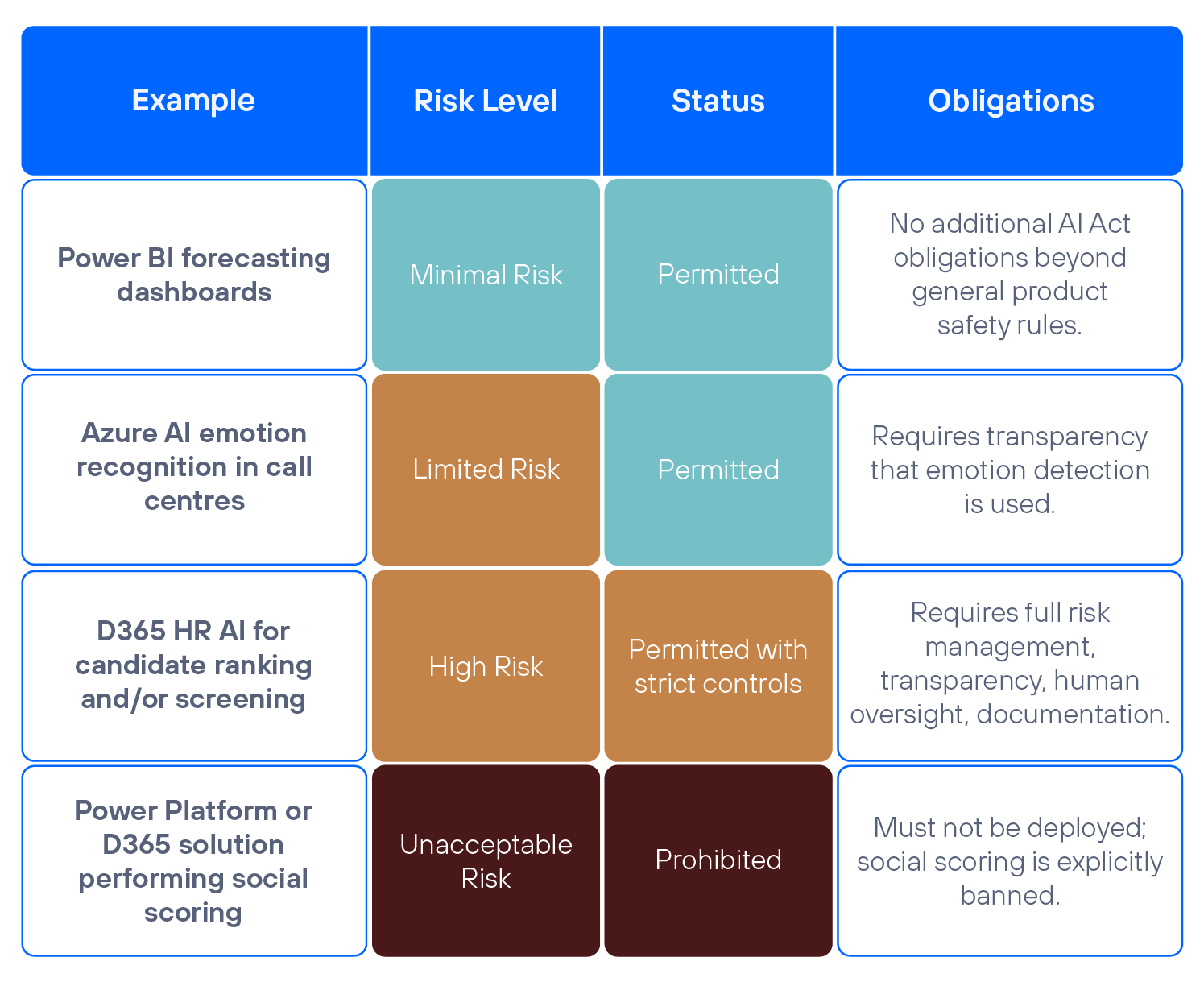
- Minimal risk, such as forecasting dashboards, which remain largely unaffected.
- Limited risk, where transparency obligations apply, for example emotion recognition systems.
- High risk, including AI used in recruitment, HR decision-making or creditworthiness assessments, which must meet stringent governance, documentation and oversight requirements.
- Unacceptable risk, such as social scoring, which is prohibited outright.
Understanding where an AI use case sits within this framework is a critical first step towards compliance.
What does AI legislation mean for Microsoft solutions?
Responsibilities under the EU AI Act depend on whether you are acting as a provider or a deployer.
When building custom AI solutions using Azure AI, Foundry or Copilot Studio, you own the AI system and are responsible for dataset documentation, safety evaluation, risk assessments, and ongoing monitoring as you are the provider of that AI solution.
When using Microsoft owned AI systems, such as Microsoft 365 Copilot or Dynamics copilots, Microsoft retains responsibility for the underlying AI as the provider. However, organisations remain accountable for data protection, access controls, acceptable use policies, user training and human oversight as deployers of those solutions.
Therefore, compliance is a shared responsibility, not something that can be fully delegated.
This means you must be ready to comply and prove that compliance.

How to get your organisation ready for AI legislation
Today, AI is prolific in business. But in order to be prepared for the future of AI legislation, before deploying AI solutions, organisations should:
- Classify AI use cases under the EU AI Act risk tiers.
- Conduct Privacy Impact Assessments (PIAs), Data Protection Impact Assessments (DPIAs) and security reviews.
- Document the AI lifecycle, including purpose, metrics and testing outcomes.
- Test for fairness, robustness, toxicity and misuse scenarios.
After deployment, logging, monitoring and human-in-the-loop oversight become essential, particularly for high-risk systems. Audit-ready documentation must be maintained as regulators gain stronger enforcement powers.
Working with a technology partner who understands AI legislation is crucial. Although responsibility is shared across provider (e.g. Microsoft) and deployer (e.g. you, the customer), a partner sits in between and must design solutions that promote compliance. It’s a key part of the conversation we have with Telefónica Tech customers during AI envisioning.
Tools to help your organisation remain compliant
Microsoft provides an integrated set of tools to support end-to-end AI compliance, which we recommend to our customers:
- Microsoft Foundry enables AI governance at build time and runtime, including model controls, guardrails, documentation and policy enforcement.
- Microsoft Purview focuses on compliance evidence, data governance and audit readiness, capturing AI interactions, applying labels and mapping regulatory requirements.
- Microsoft Defender addresses AI security risks, including malicious prompts, vulnerable models and data exfiltration.
- Purview Compliance Manager specifically translates complex regulations such as the EU AI Act, ISO 42001/23894 and NIST AI RMF into actionable assessments, tasks and compliance scores.
Together, these tools help balance innovation with security and regulatory accountability.
What key EU AI Act milestones are next?
From August 2026, the EU AI Act becomes fully operational for most organisations for general use AI. Transparency obligations apply, enforcement begins, and penalties of up to €35 million or 7% of global annual turnover can be imposed.
High-risk AI embedded in regulated products has a later deadline of August 2027, but organisations should not delay preparation. Regulators will expect evidence of AI inventories, risk classifications and governance practices well before enforcement actions begin.
Complying with AI legislation without killing innovation
AI legislation is no longer a distant or theoretical concern. With the EU AI Act legal obligations increasing and global standards converging, organisations must act decisively to understand their obligations and embed compliance into their AI strategies.
The good news is that compliance does not have to come at the expense of innovation. By adopting recognised standards, clarifying responsibilities and leveraging the right tools organisations can deploy AI responsibly, securely and at scale.
The next step is clear: build visibility into your AI estate with an AI inventory, classify your risks and treat AI governance as an ongoing operational capability rather than a one-off exercise with the Microsoft tools available across the stack to ensure compliance. Those who do so will be best placed to innovate with confidence in an increasingly regulated AI landscape.
Ensure your AI adoption is secure, strategic, and compliant. Schedule an AI & Copilot Studio Envisioning Workshop today →