The New Standard of Predictive Policing


How AI is Changing Crime Analysis and Operational Planning
Police forces have access to more information than ever before. Crime records, incident reports, intelligence data and operational performance metrics all contribute to a detailed picture of what is happening across a force area.
The challenge is not collecting data. The challenge is turning it into decisions.
Predictive policing has emerged as one approach to addressing this problem. By combining crime data, analytics and artificial intelligence, forces can identify emerging trends, understand where resources should be focused and respond to issues before they become more serious.
As AI capabilities continue to develop, predictive policing is moving beyond forecasting and towards operational decision support.
What Is Predictive Policing?
Predictive policing uses data analysis, statistical techniques and artificial intelligence to identify patterns that can help police forces anticipate crime and allocate resources more effectively.
Early predictive policing initiatives focused largely on identifying crime hotspots. Historical crime data was analysed to determine where offences were most likely to occur, helping forces target patrols and prevention activity.
The scope has since expanded considerably.
Modern predictive policing platforms can support:
- Crime trend identification
- Hotspot analysis
- Resource allocation
- Risk prioritisation
- Operational planning
- Performance benchmarking
- Problem-oriented policing
The aim is not to predict individual behaviour. Instead, these systems help forces identify patterns and trends that may require intervention.
Learn how police forces can start delivering Police Reform and Police Vision 2030 today. Read here →
Why Reporting Alone Is No Longer Enough
Traditional dashboards and reporting platforms provide valuable information about what has already happened.
They can show:
- Crime volumes
- Crime types
- Detection rates
- Geographic distribution
- Operational performance
However, officers and analysts often need to answer additional questions:
- Why is a trend occurring?
- Which areas require attention?
- What factors are contributing to the issue?
- What interventions are likely to be effective?
Finding those answers can require significant analytical effort. This is where AI is beginning to play an important role.
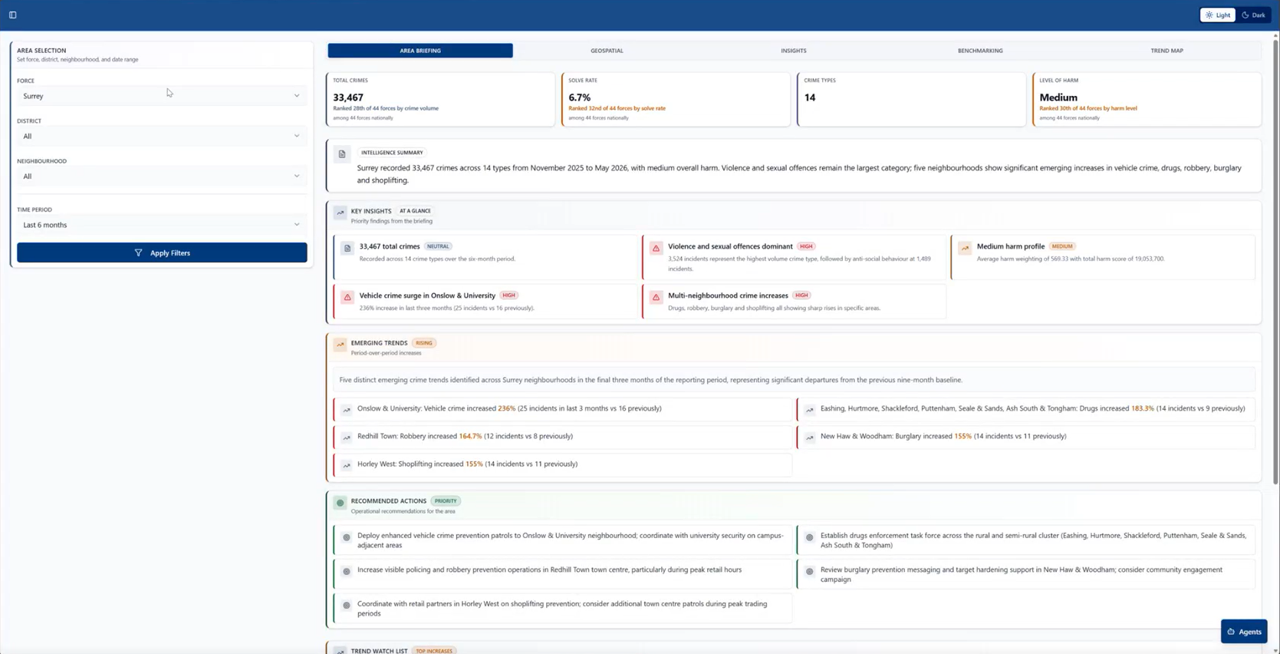
Identifying Emerging Crime Trends Faster
AI can help officers identify unusual patterns that may otherwise take longer to detect.
For example, a sudden increase in vehicle crime, antisocial behaviour or burglary within a particular neighbourhood may be highlighted automatically, allowing teams to investigate and respond more quickly.
Rather than reviewing multiple reports and datasets, officers can receive summaries that highlight:
- Significant increases in crime
- Emerging hotspots
- Changes in crime severity
- Areas experiencing deteriorating outcomes
- Neighbourhoods requiring additional focus
This helps decision-makers concentrate on the issues that require immediate attention.
Combining Crime Data with Geospatial Intelligence
Location plays a critical role in policing.
Understanding where crime is occurring can be just as important as understanding what crime is occurring.
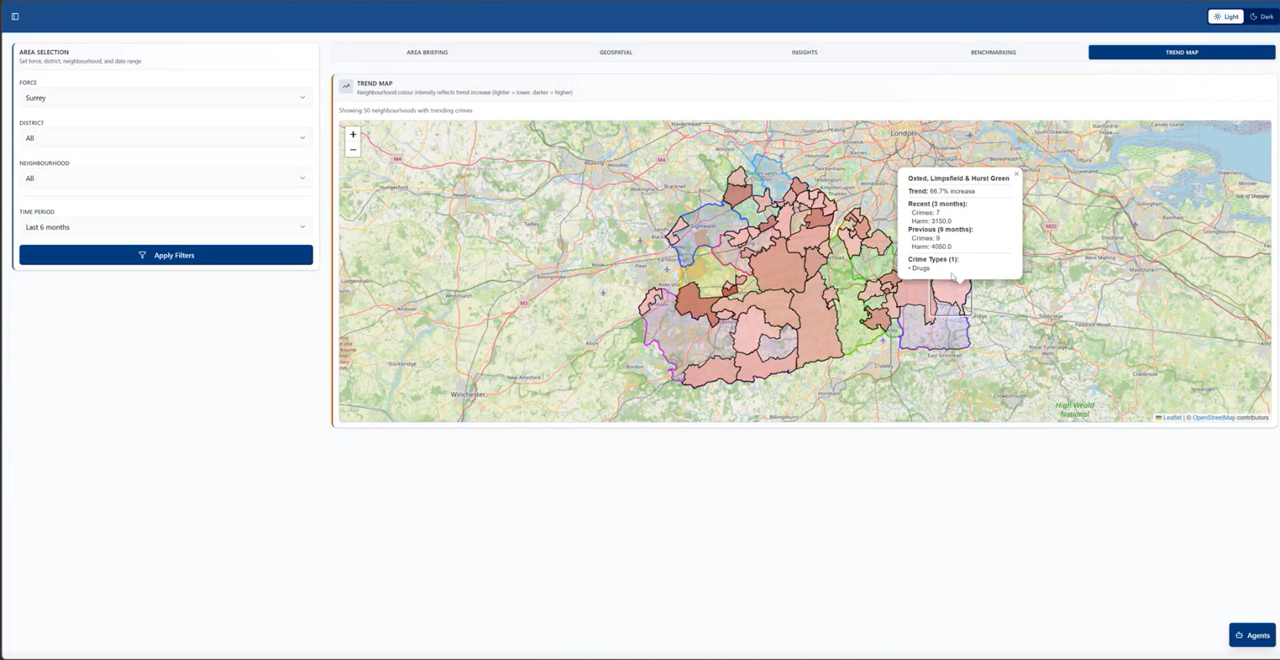
Geospatial analytics allows forces to visualise crime patterns on maps and identify hotspots that may require intervention.
When combined with historical data, officers can examine how hotspots have evolved over time and determine whether previous interventions have been effective.
This supports more targeted deployment of resources and provides greater visibility of local crime patterns.
Take a look in our demo video below and find out more about our Predictive Policing Accelerator here.
The Role of Agentic AI in Predictive Policing
A significant development in recent years has been the emergence of agentic AI.
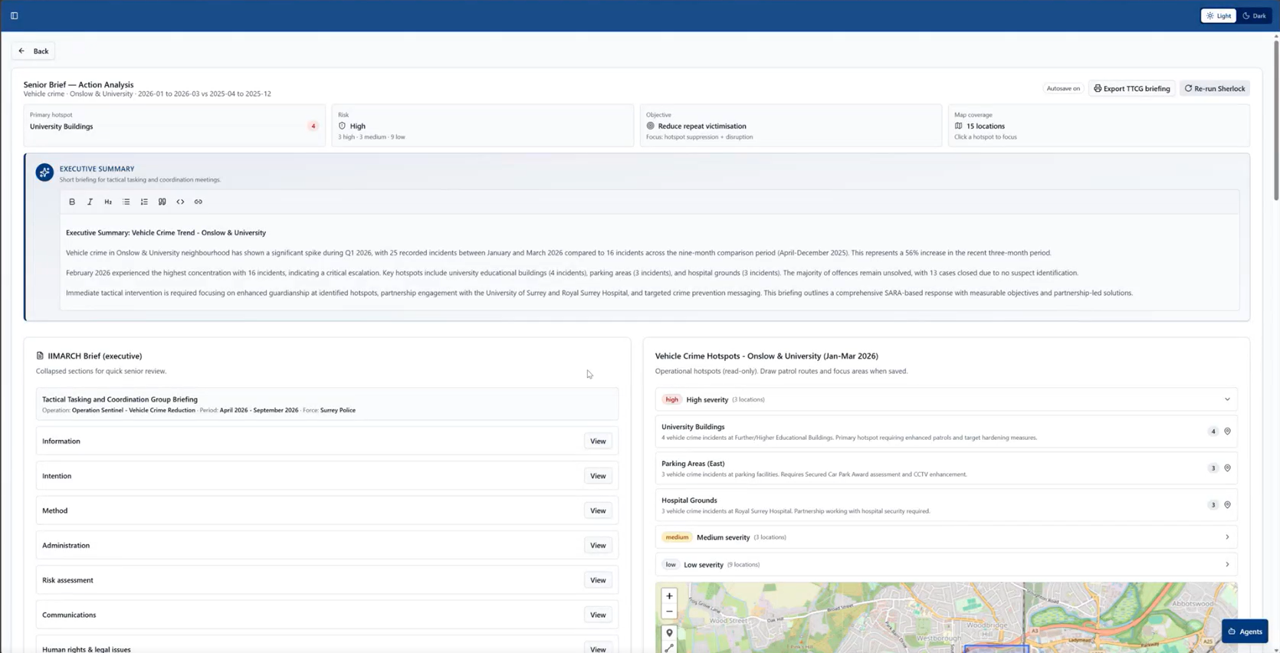
Unlike traditional AI systems that focus primarily on answering questions, agentic AI can analyse information from multiple sources, perform structured reasoning and generate recommendations.
In a policing context, this means AI can:
- Analyse crime trends
- Review performance data
- Consider professional practice guidance
- Assess contributing factors
- Recommend possible interventions
This moves predictive policing beyond forecasting and towards operational decision support.
From Analysis to Recommended Actions
One of the most time-consuming aspects of policing is translating analysis into action.
Once a problem has been identified, officers often need to:
- Investigate causes
- Review guidance
- Develop interventions
- Create briefings
- Secure resources
- Measure outcomes
AI can help reduce the time required for these activities.
By analysing crime data and recognised policing practices, AI systems can generate draft recommendations that officers can review and refine. These may include:
- Patrol strategies
- Crime prevention activity
- Community engagement initiatives
- Problem-solving approaches
- Resource allocation recommendations
The objective is not to replace professional judgement but to reduce the time spent on administrative tasks and accelerate decision-making.
Supporting Problem-Oriented Policing
Predictive policing is often most effective when combined with problem-oriented policing.
Rather than focusing solely on responding to incidents, problem-oriented policing seeks to understand why issues occur and how they can be prevented.
This typically involves:
- Scanning - Identifying the problem.
- Analysis - Understanding contributing factors.
- Response - Developing interventions.
AI can support each stage of this process by bringing together data, analysis and professional guidance into a single workflow.
Human In The Loop Remains Essential
Predictive policing technologies should support officers, not replace them.
Human oversight remains essential when interpreting trends, assessing local context and determining operational priorities.
The most effective approaches combine Data, Analytics, AI and Professional judgement.
This ensures decisions remain accountable while benefiting from faster access to information and analysis.
Read our latest blog on What is Human in the Loop and Why is it Important here.
The Future of Predictive Policing
Predictive policing is developing beyond hotspot forecasting and statistical modelling.
The combination of AI, geospatial intelligence, crime analytics and operational planning tools is creating new opportunities for forces to identify issues earlier and respond more effectively.
The focus is shifting from simply understanding what happened to helping officers determine what to do next.
As these capabilities continue to mature, predictive policing will increasingly become a decision-support capability that helps forces prioritise resources, address emerging problems and improve outcomes for the communities they serve.
See Predictive Policing in Action
Understanding emerging crime trends is only part of the challenge. The real value comes from helping officers understand why trends are occurring and what actions are most likely to improve outcomes.
Our Predictive Policing Accelerator combines crime analytics, geospatial intelligence, natural language querying and agentic AI to help forces identify emerging issues, assess their impact and develop operational responses faster.
Book a Predictive Policing Accelerator demo to see how AI can support crime trend analysis, hotspot identification and operational planning within your force. Book a demo →