
What is Human in the Loop and Why Does It Matter?


Human in the Loop (HITL) is about achieving the optimal balance between human judgement and AI capability. In other words, it’s the right Human: AI agent ratio for each task, workflow and decision.
As our customers move beyond AI experimentation to strategic transformation, success is being measured by business outcomes – fundamental to which, is keeping humans “in the loop”.
At its core, HITL ensures that AI augments human decision-making rather than replacing it. In practice, this manifests in three broad operating patterns:
- Every employee is supported by an AI assistant
- AI agents act as “digital colleagues” within teams
- Humans set direction while AI executes processes at scale
But HITL is often misunderstood.
What HITL is not:
- It is not simply adding a human “approval step” at the end of an automated workflow
- It is not passive oversight or rubber-stamping AI outputs
- It is not slowing down automation with unnecessary intervention
True HITL means active, accountable human involvement where people shape goals, challenge outputs, and take responsibility for decisions.
How does HITL help decision makers?
The growing need for Human in the Loop is closely tied to a broader leadership shift.
As AI becomes embedded in organisations, leaders are using machines to inform (but not define) outcomes. They are becoming AI-augmented decision makers.
This distinction matters because AI has clear boundaries. It can analyse, generate and optimise, but it cannot determine what should matter in the first place.
What can AI not do?
- Aspiration: AI pursues goals but does not define them. Leaders decide which problems are worth solving.
- Judgement and empathy: AI has no stake in consequences and cannot be accountable for harm, fairness or customer impact.
- Creativity: AI works from patterns in past data, while breakthrough ideas often challenge precedent and require risk and belief.
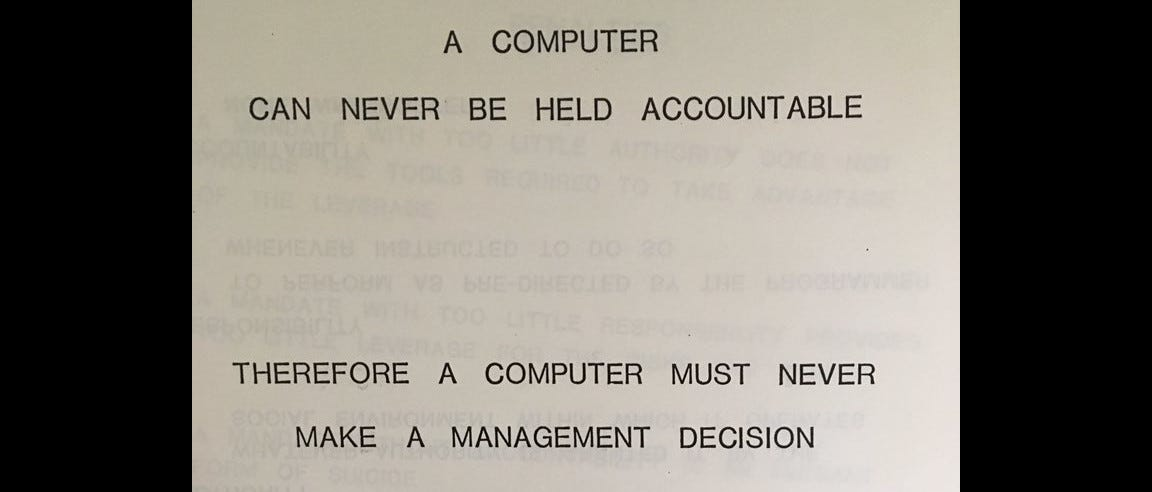
This is why HITL is not optional. It is the mechanism that ensures AI is used with intention, not just capability.
Addressing the “boring” side of AI
Much of the conversation around AI focuses on models, innovation and potential. In reality, the harder and more important work sits elsewhere: governance, data and operational control.
These are the foundations that need addressed before the “fun” stuff. Just like I tell my kids, eating your vegetables first gets it over with.
We’re seeing organisations quickly discover that AI success depends less on model performance and more on the foundations underneath it. Most effort is spent on data quality, permissions and ownership, and poor governance can amplify mistakes at speed – turning small issues into systemic failures.
This is where HITL becomes critical. Human involvement ensures that:
- data is trusted and understood
- outputs are challenged, not assumed to be correct
- accountability is clear, especially where decisions affect customers
It also helps organisations navigate a fundamental tension.
On one side sits ambition i.e. experimentation, speed and innovation. On the other sits control i.e. governance, regulation and risk management. Move too far in either direction and problems emerge: chaos if you move too fast, stagnation if you move too slowly.
HITL provides the balance point between the two.
The way this balance is achieved varies by organisation. Factors such as internal data maturity, cultural attitudes to risk, customer expectations and market pressures all shape how much autonomy AI is given and where human oversight is required.

Why are skills and culture just as important as technology?
HITL only works if people understand how to engage with AI effectively. This is why AI literacy is becoming a core leadership capability, not a niche technical skill.
A key starting point is understanding AI’s limitations. AI systems can be confidently wrong, lack true context, and depend heavily on the quality of the data and design behind them. Their outputs are probabilistic, not guaranteed.
Without this understanding, organisations risk two extremes: over trusting AI or rejecting it altogether.
Equally important is the distinction between being on the loop and in the loop. Passive oversight (e.g. simply approving outputs) is no longer sufficient, particularly in regulated environments. Meaningful involvement requires authority, expertise and a willingness to challenge AI decisions when needed.
To support this, organisations need a clear view of where AI is being used. An effective approach typically includes:
- identifying decisions influenced by AI
- mapping where AI affects customer journeys
- distinguishing between experimental and business critical use cases
It’s a model we use in our Prism framework for agentic AI adoption.
Alongside this, leaders must recognise the growing impact of behavioural risk. People may over rely on AI, assume it is objective, or disengage from critical thinking. These risks are subtle but significant and they are only mitigated when humans remain actively engaged in the loop.
The difference between AI “Oops” and AI Ops
Many organisations are still in a phase of experimentation – they’re running pilots, testing use cases and exploring possibilities. This is where “AI oops” can happen: starting with the technology rather than the problem, overlooking data foundations, or neglecting governance until issues arise.
Scaling AI is a different challenge entirely. It requires moving from isolated experiments to repeatable, operational capability — what can be described as “AI operations” (or AI Ops for my snappy subtitle).
The difference comes down to discipline. Organisations that succeed tend to:
- embed AI into real workflows rather than layering it on top
- establish clear governance, ownership and accountability
- design systems with human oversight built in from the start
HITL is the thread that connects all of this. It ensures that AI remains aligned to business outcomes, that risks are managed proactively, and that decisions remain accountable even as automation increases.
Ultimately, HITL is not about slowing AI down. It is about making AI work properly at scale. And as organisations move from experimentation to operationalisation, it will be the factor that separates those who unlock value from those who create unintended consequences.
Get help applying Human in the Loop principles at your organisation. Speak to our experts today →