

How Databricks governance supports responsible AI and Police AI Principles


Co-authored by Josh Bramall, Solution Architect at Databricks
As UK police forces move from AI experimentation into operational use, the question is no longer whether AI can deliver insight, it’s whether forces can prove how that insight was produced, who saw it, and why it was acted on.
The NPCC’s Police AI Principles and the Responsible AI Checklist for Policing set a clear bar: AI in policing must be lawful, transparent, explainable, and subject to human oversight. Meeting that bar is a governance problem before it is an AI problem.
This blog sets out how the Databricks platform, deployed by Telefónica Tech, gives police forces the governance foundation the principles require across data, models, and the full AI lifecycle.
Why governance is the foundation for responsible AI
Responsible AI depends on strong governance. The AI Playbook for Policing is explicit: forces must balance innovation with oversight, accountability, and ethical use of data across the full lifecycle. Without governance, it is difficult to understand how data is being used, explain how decisions are made, or maintain accountability for outcomes. Governance is what enables responsible AI to move from theory into practice.
Mapping Databricks to the Police AI Principles
The Databricks platform includes governance as a core capability not as a layer added on top. Through Unity Catalog, MLflow, and an end-to-end approach to lineage and audit, the platform’s capabilities map directly to the Police AI Principles.
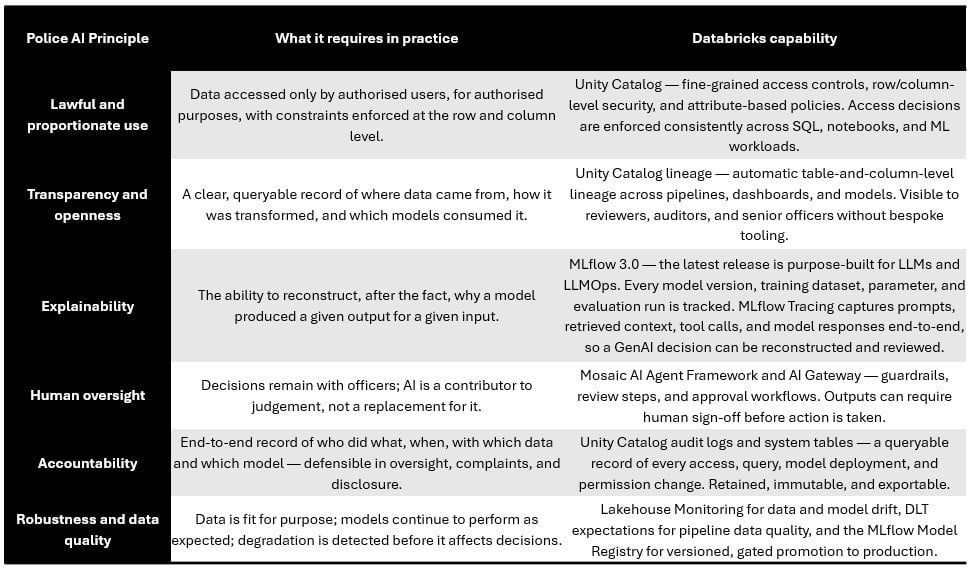
MLflow is open source. It is the industry-standard tool for managing the ML and LLMOps lifecycle, with broad adoption outside Databricks. Inside Databricks, MLflow is deeply embedded into Unity Catalog, lineage, and model serving meaning the same tracking, audit, and governance applies whether forces start with open-source MLflow or operate it on the Databricks platform. Forces are not locked in.
These capabilities apply at every stage of the AI lifecycle from data ingestion and feature preparation, through model development and evaluation, into production deployment, and on to ongoing monitoring. Governance is not a checkpoint at the end. It is built into the platform that the data and models live on.
From principles to practice: policing use cases
The Police AI Principles are not abstract — they apply to specific operational decisions every day. Two examples bring the principles into focus:
- Predictive policing— where transparency, explainability, and proportionality must be evidenced before any operational deployment.
- Clare's Law and safeguarding — where lawful use, accountability, and human oversight directly affect the people the force has a duty to protect.
Both demonstrate how responsible AI, applied with the right governance, supports better operational and safeguarding outcomes.
- Read how Databricks Genie supports predictive policing
- Read how Databricks Genie supports Clare’s Law
Why Telefónica Tech and Databricks
The Police AI Principles set a clear governance bar. Meeting it in practice — across legacy data estates, complex authorities, and operational pressures takes more than a platform.
Police forces don’t just need AI that performs well, they need AI they can trust, govern, and defend operationally. Telefónica Tech combines deep UK public sector experience, accredited Databricks expertise, and proven policing delivery capability to help forces adopt AI responsibly from day one. Together with Databricks, we provide a governed-by-design foundation that enables forces to innovate confidently while aligning to the Police AI Principles at every stage of the AI lifecycle.
Together with Databricks, we deliver responsible AI as it is meant to work: governed by design, evidenced end-to-end, and trusted by the officers and analysts who depend on it.
Beyond technology: building a data culture
Responsible AI is not only a platform question. The strongest governance controls cannot compensate for a workforce that doesn’t trust its data, processes that vary by team, or decisions made without a shared understanding of how the underlying systems work.
A capable data culture the people, the data guardianship, the enablement, and the underlying technology is what allows responsible AI to scale beyond a single use case and become how the force operates.
Without it:
• AI initiatives stall after the first proof of concept
• Governance is applied retrospectively rather than by design
• Officers and analysts struggle to trust outputs they cannot interrogate
We explore this in more detail in our Building a Data Culture blog.
See it in action
The Police AI Principles raise the bar and the right combination of platform and partner makes meeting that bar achievable, not aspirational.
If you are evaluating how to apply AI responsibly in your force, whether that is operational analytics, safeguarding, or generative AI we can take you through a working environment that demonstrates the governance, lineage, and audit capabilities described in this article, mapped against the principles your force is held to.