

Building an Enterprise AI Platform: What Organisations Need to Get Right


AI experimentation is accelerating, but moving individual initiatives into production remains a challenge for many organisations.
An Enterprise AI Platform provides the shared architecture, data connections, governance and controls needed to take AI beyond isolated proof of concepts. It helps organisations establish a repeatable approach to developing, deploying and managing AI, while supporting the wider strategy, skills and operating processes needed for adoption.
A successful proof of concept demonstrates what might be possible. Production requires an organisation to understand how that solution will operate, who will use it and what needs to be in place to manage it over time.
Why do AI pilots struggle to reach production?
Several challenges can prevent promising AI initiatives from progressing beyond experimentation.
1. AI activity is not connected to business priorities
Organisations can end up with multiple teams experimenting with AI without a clear view of which opportunities matter most. A use case might demonstrate technical potential but have limited business value, or it may be difficult to implement within existing processes.
Moving forward requires a clear understanding of the problem being addressed, the expected outcome and how success will be measured. AI strategy should help organisations prioritise opportunities based on business value, feasibility, risk and readiness.
2. Data foundations are not ready
AI solutions depend on access to relevant, trusted information. If data is fragmented across systems, poorly managed or difficult to access securely, it can limit what an AI solution can achieve.
Organisations need to understand where the required information sits, who owns it, how it is governed and what access the AI solution should have. This does not mean every data issue must be resolved before AI can begin. It means identifying the data requirements for each use case and addressing the gaps that could affect its performance, security or reliability.
3. Governance and security are considered too late
A prototype may work in a controlled environment, but deploying it across an organisation introduces additional responsibilities. Organisations need to consider:
• Which models and services are being used.
• What information they can access.
• How user permissions are applied.
• How AI interactions are monitored.
• How risks and inappropriate outputs are managed.
• What evidence is available for audit and oversight.
These requirements should be designed into the solution rather than added as a final approval step.
4. Technology becomes fragmented
Different teams may select different models, development tools and integration approaches. This can make it difficult to manage solutions consistently, particularly when AI needs to connect with enterprise applications, data platforms and external services.
A shared architecture can help establish reusable patterns for integration, model access, deployment and governance. It also allows organisations to select technologies based on their requirements without creating a completely separate environment for every use case.
5. Costs and usage are difficult to understand
As AI solutions move into production, organisations need to understand the resources they consume. Model and token usage can vary considerably between use cases. Without monitoring and cost attribution, it can be difficult to understand where spend is coming from or whether a particular model is appropriate for the task.
Organisations need visibility of consumption, with the ability to set budgets, introduce limits and identify opportunities to optimise usage.
6. People and processes are not ready
Even a well-designed AI solution can struggle if it does not fit the way people work. Employees need to understand what the solution does, when to use it and where human oversight remains important. Business processes may also need to change to accommodate new ways of working.
Successful adoption therefore requires more than deploying technology. It needs clear ownership, appropriate training and ongoing feedback from the people using the solution.
How an Enterprise AI Platform helps
An Enterprise AI Platform provides shared foundations to help organisations address these challenges.
Rather than developing and managing every AI solution independently, organisations can establish a common environment for connecting data and systems, integrating models, building agents and applications, and applying governance.
This creates a more consistent way to take individual use cases into production.
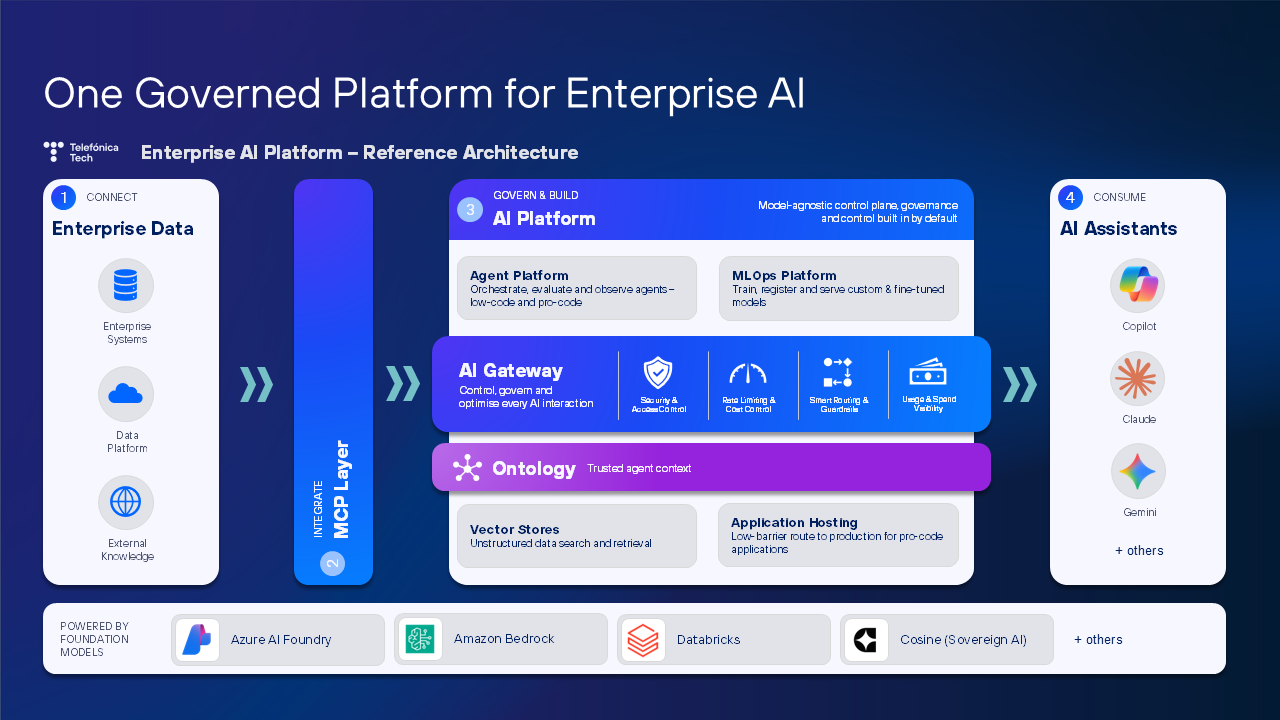
A platform architecture can bring together four key areas:
- CONNECT: Make relevant enterprise data, systems and knowledge available to AI solutions.
- INTEGRATE: Provide controlled connections between AI services and existing technology, with appropriate access permissions.
- GOVERN AND BUILD: Manage models, agents and applications within a shared environment, supported by security, monitoring and cost controls.
- CONSUME: Make AI available through existing applications and business workflows.
The architecture should be flexible enough to support different models and technologies, while maintaining consistent governance and oversight.
From experimentation to a repeatable approach
An Enterprise AI Platform is an important enabler, but it is not a substitute for the wider foundations needed to make AI successful.
Organisations should consider a practical approach.
- Define the business problem
Start with a clear use case, its intended outcome and how value will be measured. Prioritise opportunities based on business impact, feasibility and risk. - Understand the requirements
Identify the data, integrations, models, permissions and infrastructure needed. Consider security, regulatory and deployment requirements early. - Establish the foundations
Put the appropriate data, architecture, governance and operating processes in place. Reuse shared platform capabilities wherever possible. - Build and evaluate
Develop the solution, test its performance and assess its behaviour against defined requirements. Include appropriate guardrails, monitoring and human oversight. - Deploy and embed
Integrate the solution into the workflows where people will use it. Establish ownership, support processes and guidance for employees. - Monitor and improve
Track usage, costs, performance and feedback. Use these insights to improve the solution and inform future AI opportunities.
Making AI work beyond the pilot
The challenge for organisations is no longer simply proving that AI can work. It is establishing the strategy, data, architecture, governance and skills needed to use it consistently.
An Enterprise AI Platform provides a shared foundation for this, helping organisations move beyond isolated experiments towards a more controlled and repeatable approach to AI.
Telefónica Tech brings together expertise across Data, AI, Cloud, Business Applications and Cyber Security to help organisations establish these foundations and develop their enterprise AI capabilities.
Explore Telefónica Tech’s Enterprise AI Platform to understand how a governed, repeatable approach can help build AI into the way your organisation works. Talk to our Enterprise AI team →