
What Is an Enterprise AI Platform? A Guide to the Foundations of Enterprise AI


An Enterprise AI Platform is a shared, governed technology environment that enables organisations to develop, deploy, manage and scale AI solutions. It connects enterprise data and systems with AI models, agents and applications, providing the architecture, integration, security and governance needed to use AI consistently across an organisation.
Rather than managing each AI initiative independently, an Enterprise AI Platform establishes reusable capabilities and controls that support enterprise-wide AI adoption.
As organisations introduce more AI tools, assistants and applications, having these foundations in place becomes increasingly important.
Why do organisations need an Enterprise AI Platform?
AI initiatives often begin with a specific business requirement. A team might want to introduce an assistant, automate a task or build an application around a particular AI model.
But as more use cases emerge, the technology and operational requirements become more complex.
Different teams may select different models and tools. Data access may be managed inconsistently. Security teams may have limited visibility of how AI is being used, while costs can become harder to attribute to individual applications or use cases.
Without shared foundations, each new initiative can introduce additional complexity.
An Enterprise AI Platform helps address this by providing common capabilities that can support multiple AI initiatives.
What are the main components of an Enterprise AI Platform?
An Enterprise AI Platform brings together several connected capabilities. The exact architecture will depend on an organisation’s existing technology environment, requirements and approach to AI.
1. Trusted enterprise data
AI solutions need access to relevant information and business context to produce useful outputs. That means understanding where data is held, how it is managed and what information different users and applications are authorised to access.
Trusted data foundations, appropriate permissions and well-designed integration help connect AI to the information it needs without creating unnecessary exposure or duplication.
2. Integration with enterprise systems
AI needs to interact with more than models and data platforms. Many use cases require connections to business applications, operational systems, external services and other sources of information.
An integration layer provides a controlled route between these systems and AI services. Technologies such as Model Context Protocol (MCP) can also support connections between AI applications, tools and data sources where appropriate.
Access should be designed around defined permissions and security requirements.
3. AI models and agent capabilities
Different use cases may require different AI models and approaches. An organisation might use a foundation model for a conversational assistant, a smaller model for a more specific task or a custom model developed around its own requirements.
An Enterprise AI Platform can provide a shared environment to connect, manage and deploy these capabilities. It can also support the development and orchestration of agents, which may need to interact with enterprise systems, retrieve information or complete tasks across different applications.
4. Governance, security and oversight
As AI adoption grows, organisations need to understand which models, agents and applications are being used, what they can access and how their activity is monitored.
A shared platform can provide consistent controls around model access, permissions, guardrails and usage. It can also provide visibility through logs and monitoring, helping organisations understand how AI is interacting with their systems and information.
Governance should not be treated as something added after an AI solution has been built. It needs to be considered as part of the architecture from the beginning.
5. Usage and cost management
As organisations introduce more AI services, understanding consumption becomes increasingly important. Model and agent usage can generate costs through inference and token consumption. Without visibility, it can be difficult to understand which use cases are consuming resources and whether the chosen models are appropriate.
A platform with monitoring and cost management capabilities can help organisations:
- Attribute usage to individual applications or use cases.
- Monitor model and token consumption.
- Introduce budgets and usage limits.
- Identify opportunities to optimise model selection.
- Understand how AI services are being used.
This gives technology and business teams a clearer view of the costs associated with AI adoption.
6. Application hosting and consumption
AI creates more value when people can use it within the applications and processes they already understand.
An Enterprise AI Platform can support the deployment of AI-powered applications, assistants and agents, integrating them into existing workflows rather than requiring employees to move between disconnected tools. This also makes it easier to build on successful use cases and extend them across teams.
What does an Enterprise AI Platform architecture look like?
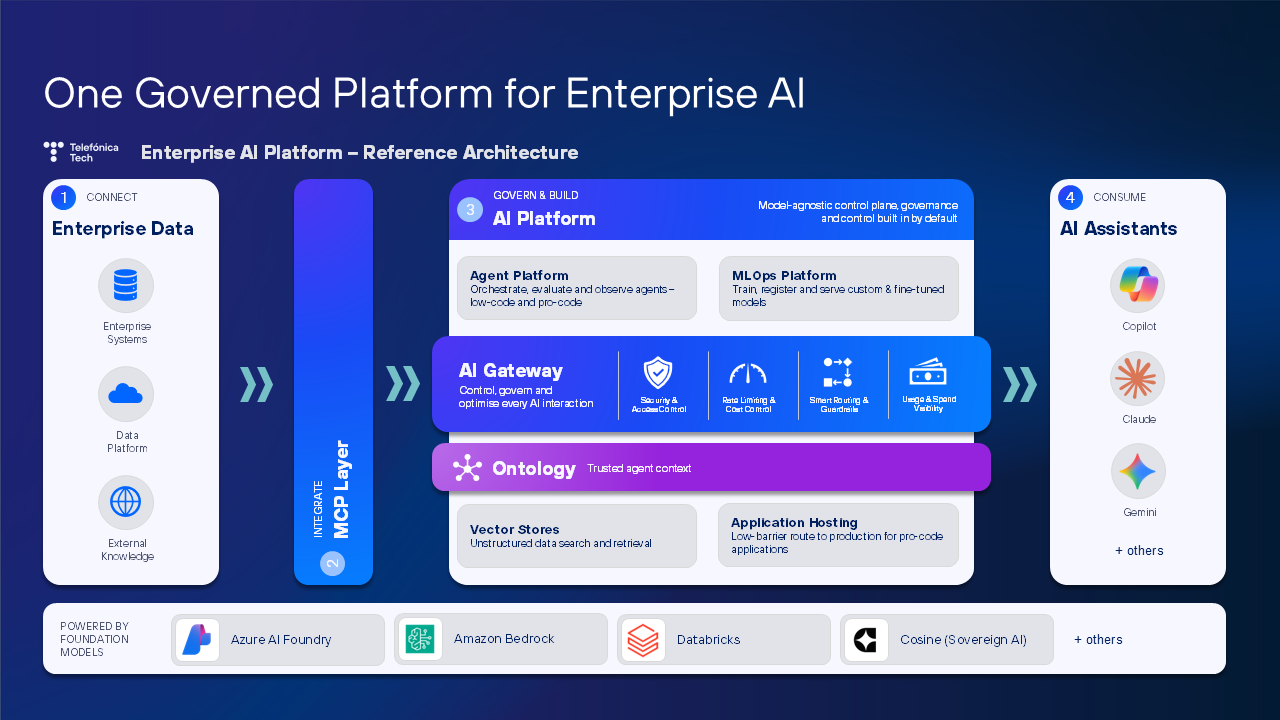
There is no single technology stack that every organisation needs to adopt. However, a reference architecture can help explain the main components and how they connect.
A typical approach brings together four areas:
- CONNECT: Access enterprise data, systems, applications and external knowledge.
- INTEGRATE: Establish controlled connections between AI services and the wider technology environment, with appropriate permissions.
- GOVERN AND BUILD: Provide a shared environment for models, agents and applications, with governance, monitoring and cost controls.
- CONSUME: Make AI available through the applications and workflows where people need it.
The specific technologies will depend on the organisation’s existing environment, requirements and preferred deployment approach.
For example, Databricks offers capabilities including Unity AI Gateway, which can help organisations govern and monitor AI interactions within a Databricks environment.
Other technologies and platforms can also contribute to an Enterprise AI architecture. The important point is that the architecture should support the organisation’s requirements rather than forcing every use case into one product or model.
Is an Enterprise AI Platform the same as an AI strategy?
No. An AI strategy defines what an organisation wants to achieve with AI, where it can add value and which opportunities should be prioritised.
An Enterprise AI Platform provides the technical and operational foundations to help put that direction into practice.
Both are important.
Organisations still need business sponsorship, a clear understanding of priority use cases and a practical roadmap. They also need trusted data, security and governance, the right skills and an operating model that supports ongoing management.
These foundations need to develop alongside the platform.
A technically capable environment will not deliver its intended value if people do not understand how to use it, business processes are not ready or there is no clear ownership of the solutions being deployed.
How do you build an Enterprise AI Platform?
There is no single starting point for every organisation. A practical approach should reflect existing technology, AI maturity, business priorities and the requirements of individual use cases.
A typical journey includes:
- Explore: Assess AI maturity, identify opportunities and define priorities.
- Establish: Prepare data, design the architecture and put governance and security requirements in place.
- Scale: Move successful use cases into production and extend adoption across teams.
- Optimise: Monitor usage, improve existing services and introduce further use cases as requirements evolve.
This creates a route from initial AI ambitions to a more consistent enterprise capability.
Building a foundation for enterprise AI
As organisations move beyond individual experiments, the challenge is to create a repeatable approach to developing, governing and managing AI.
An Enterprise AI Platform helps bring the necessary components together, connecting data and systems with models, agents and applications through a shared architecture.
Telefónica Tech helps organisations assess their starting point, establish the right foundations and develop a practical route towards enterprise AI adoption.
Explore Telefónica Tech’s Enterprise AI Platform to understand how a governed, repeatable approach can help build AI into the way your organisation works. Talk to our Enterprise AI team →