Microsoft Fabric vs Power BI – Which Is Right for Your Organisation?


If you’re comparing Microsoft Fabric vs Power BI, you’re likely beyond early research and trying to decide how to move forward with your data and analytics strategy.
Although they’re closely related, Microsoft Fabric and Power BI are designed for different levels of analytics maturity. Understanding how they work together and when each is appropriate is critical to avoiding unnecessary cost, complexity, and rework.
This guide explains the differences clearly, outlines real-world use cases, and helps you decide which option fits your organisation today and tomorrow.
Microsoft Fabric vs Power BI: The Simple Explanation
Microsoft Fabric and Power BI are not competing tools.
- Power BI is a business intelligence and reporting platform
- Microsoft Fabric is an end-to-end analytics platform that includes Power BI
In short, if your organisation mainly needs dashboards and reports, Power BI may be sufficient. If you need to manage, engineer, govern, and analyse data at scale especially with AI in mind, Microsoft Fabric is designed for that purpose.
Learn more about Microsoft Fabric Learn more about Microsoft Power BI
When Power BI Is Enough
Power BI is often the right choice if:
- You already have a stable data warehouse or lakehouse
- Your priority is reporting and insight, not data engineering
- You want fast time-to-value for business users
- Your analytics requirements are relatively simple
For many organisations, Power BI is the foundation of their analytics capability and can deliver significant value on its own.
When Microsoft Fabric Becomes the Better Option
Microsoft Fabric is typically the better choice when:
- Data is spread across multiple platforms and tools
- Reporting is slow, inconsistent, or difficult to govern
- Data engineering, BI, and data science teams operate in silos
- You’re planning advanced analytics or AI initiatives
- Platform sprawl and cost are becoming an issue
Fabric addresses these challenges by unifying analytics into a single, governed platform.
Microsoft Fabric vs Power BI: What Actually Changes?
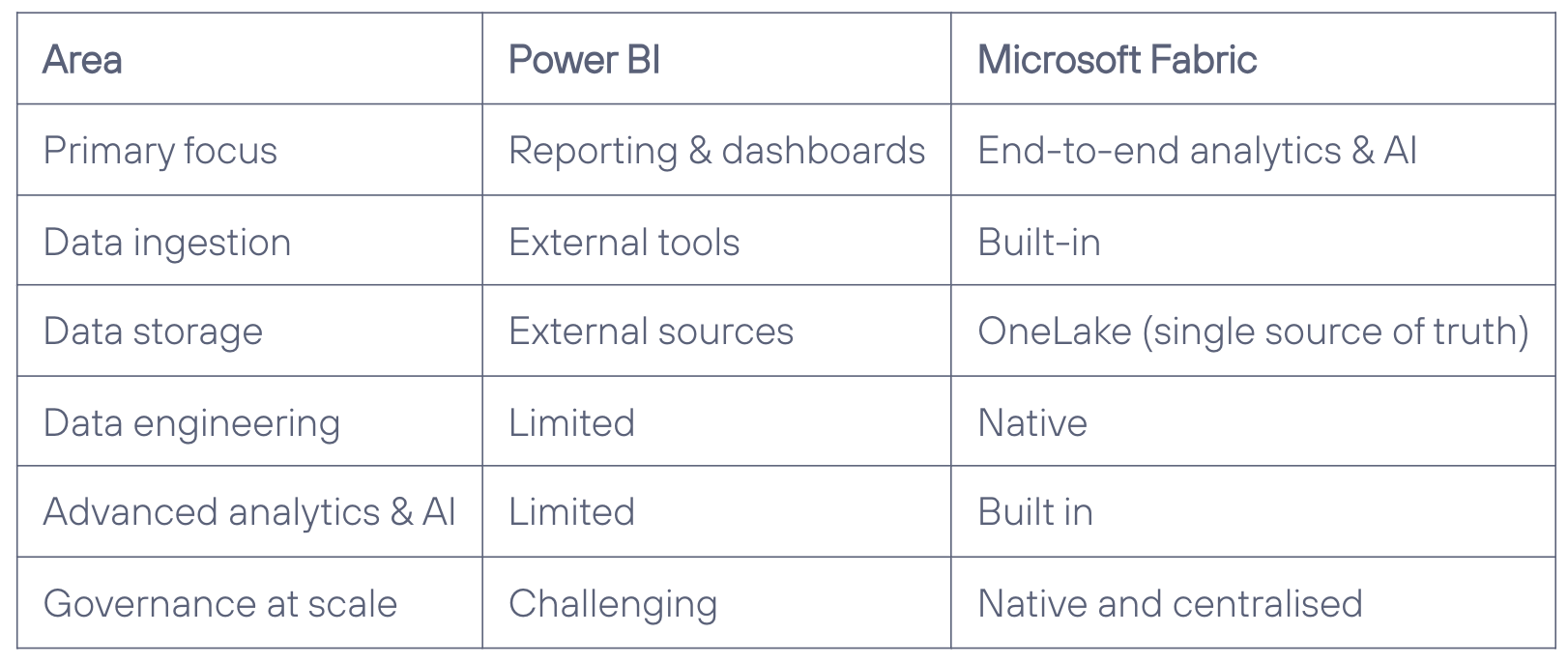
What Microsoft Fabric Adds Beyond Power BI
Microsoft Fabric extends Power BI by providing a unified analytics experience that includes:
- Data ingestion and orchestration
- Centralised storage in OneLake
- Data engineering and transformation
- Data science, machine learning and AI
- Real-time analytics
- Power BI semantic models, dashboards, and reports
This removes duplication and fragmentation, enabling teams to move from raw data to insight within one platform.
Is Microsoft Fabric Replacing Power BI?
No. Microsoft Fabric does not replace Power BI.
Power BI remains the visualisation and reporting layer and continues to be used on its own or within Fabric. Microsoft Fabric simply extends Power BI by adding enterprise-grade data engineering, governance, and AI capabilities around it.
Should You Use Microsoft Fabric or Power BI?
The decision is rarely “either/or”.
- Use Power BI when reporting is your primary need
- Use Microsoft Fabric when your analytics ambition grows and requires scale, governance, and AI
- Use both together to create a modern, future-ready Microsoft analytics platform
The real decision is not about tools, it’s about how to evolve your analytics capability without increasing risk or complexity.
Implementing Microsoft Fabric Successfully
Choosing the right platform is only part of the challenge. How Microsoft Fabric is designed and implemented determines long-term success.
Telefónica Tech focuses on a business-first, not tool-led approach, helping organisations:
- Align Fabric capabilities to clear business outcomes
- Prioritise high-value analytics and AI use cases
- Design secure, governed OneLake environments
- Implement role-based access and data security
- Control Fabric capacity and cost from day one
Whether organisations are:
- Starting with Power BI
- Modernising legacy data platforms
- Scaling advanced analytics and AI
As a Microsoft Feature Fabric Partner, Telefónica Tech supports the entire Microsoft Fabric journey, from strategy to production.
Summary - Microsoft Fabric vs Power BI
- Use Power BI for fast, effective reporting
- Use Microsoft Fabric when analytics complexity and ambition increase
- Use both together to create a modern, scalable Microsoft data platform
If you’re evaluating Microsoft Fabric vs Power BI, the real decision is not which tool but how to evolve your analytics capability without adding risk or complexity.
Take the Next Step with Microsoft Fabric
To help organisations move from comparison to confidence, Telefónica Tech offers:
A complimentary 1-hour Microsoft Fabric briefing, to clarify fit, value, and next steps.
These options provide a fast, low-risk way to decide whether Microsoft Fabric is right for your organisation and how to implement it successfully.