
FinOps In the Era of Agents: How Agentic FinOps Is Reshaping Teams, Tooling and Operating Models


Introduction
FinOps is entering a new phase of maturity. One of the predictions we made last year was that AI-driven FinOps capabilities would become a central theme in 2026. That prediction is rapidly becoming a reality with the introduction of ‘FinOps Agents’. Agents are a game changer in re-thinking a cloud FinOps function, its priorities, ways of working and FinOps skills profile.
Layering In New Capabilities with FinOps Agents
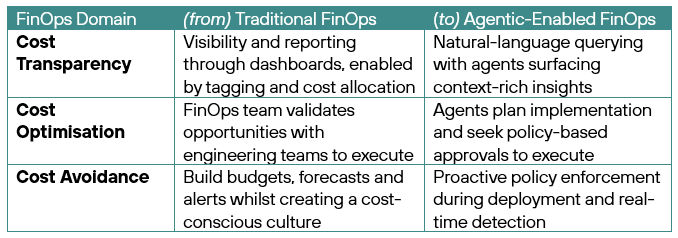
The key distinction is that automation has always been available to FinOps teams operating cloud environments, whether that’s serverless functions to automatically terminate zombie resources or alerts based upon thresholds. What agents now introduce is the ability to plan multi-step actions and independently collaborate across multiple teams.
New FinOps Products and Agent Capabilities
Microsoft have launched an ‘Optimization Agent’ for FinOps use cases via CoPilot studio for Azure environments. Through natural language conversations, the FinOps agent can explain resource utilisation and cost optimisation recommendations and then generate the CLI or PowerShell scripts to implement the changes.
However, it is in preview and only supports Azure VMs and VM Scale-Sets as eligible resources. It also does not automatically update IaC modules or templates. If you were to run the agents’ scripts manually, your deployed resources could drift from the IaC source of truth. We expect this feature is set to mature moving forwards.
Cloudability is also expanding their AI-driven FinOps capabilities for cloud cost management. Beta currently has natural language query capabilities, or in plain speak, a FinOps chatbot. This will enable users to use AI to ask for deeper insights into their cost and usage data, rather than building out reports to find the information they need. Users can then ask ‘why did my spend go up this month?’ and the new AI feature will highlight the cloud products or resources which led to that increase.
This solves one of the tasks which is most draining for a FinOps team; other teams asking for standard reports and insights to be built into a dashboard which are only looked at once. If this new functionality can mean anyone, regardless of their cloud and FinOps ability, can query and understand cloud costs, the reach of FinOps inside an organisation will expand.
What This Means for FinOps Teams
Assuming Agentic AI is here to stay and will mature, there could be a big shift in the structure and focus of a FinOps team.
Traditionally, FinOps team have followed a similar pattern, a FinOps lead supported by two-to-three analysts. The lead was interfaced into the business team to drive cloud cost intelligence and ownership, whilst the analysts operated tooling platforms, built dashboards, validated optimisation opportunities and responded to anomalies.
Agents will be a game changer if they can provide cost insights directly to engineering or finance teams, surfacing optimisation opportunities with scripts to execute, and independently identify and eliminate zombie resources, with minimal to no interference from the FinOps team. A big if, but an exciting if.
Consider the scenario where you have identified an associated IP address. It probably costs less than $5 daily. Assuming you have not already built automations to identify and delete zombie resources, the human cost of an engineer executing this activity might not stack up, especially if they have conflicting priorities for other cloud engineering tasks.
FinOps agents changes this. The limiting constraints is not human time and prioritising FinOps activities but having the governance model.
A New FinOps Operating Model Emerges
This evolution does not eliminate FinOps teams and talent. It changes the mindset and skills profile of that team.
The mindset should be to treat FinOps like a product. The ‘FinOps Lead’ title could shift to ‘FinOps Product Owner’ and take overall ownership for the FinOps priorities, outcomes, policies, and thresholds within an organisation. They decide where automation and agents are allowed to act autonomously and where it must require a human in the loop.
The ‘FinOps Analyst’ role shifts towards ‘FinOps Engineers’ who are hands on cloud cost engineers implementing the guardrails for agents to operate within, validating their actions, and tuning agents based on context such as environments, applications, and criticality. As agents can operate continuously across every subscription or account, the results is a smaller central team with far greater reach and influence.
Shifting FinOps Left
Agentic FinOps continues to accelerate this trend. Rather than analysts building and configuring cost dashboards to share spend trends with engineers, agentic FinOps enables agents to step in with real-time intervention. This could be the immediate identification and surfacing of waste directly to the engineer as their ‘FinOps Team Mate’ or agents taking anomaly detection directly to the engineer and explaining what caused the spike whilst also providing them the IaC or script to execute the change.
UK CTOs should expect the next evolution of FinOps teams to increasingly sit alongside platform engineering or SRE teams, rather than reporting to a finance function.
Where To Start with Agentic FinOps
To start experimenting and innovating with agentic FinOps, pick 2-3 uses cases with a high ROI but safe risk threshold to test the capabilities of FinOps agents. If I were a CTO, I would start with:
Anomaly Triage Agent
- Purpose: prove how agents can reduce time-to-intervention by maturing anomaly detection with automated and context-aware triages to enable engineers to make faster decisions.
- Process: build an anomaly triage agent to continuously monitor cloud spend, and detect abnormal spends for subscriptions or applications against historic spend data. Generate a clear explanation of what changed and why. Provide a small set of response options to remediate. Route and communicate directly to tagged owner/team for the workload.
- Outcome: Owners act faster and analysts are no longer the bottleneck. Human in the loop creates trust as no action is taken autonomously.
How To Build
To bring these agents to life inside an Azure environment, starting with GitHub Copilot Agent skills would be a good place. It can operate as the orchestrator plus build each FinOps agent with a set of reusable skills.
- Define the operating context: codify the boundaries the agent must respect. In this case, the Azure subscriptions in scope, owner mapping from tags and decision rights for notify vs auto-remediate.
- Create a project skill pack per FinOps agent: a skills directory with each skill, anomaly triage and non-prod-hygiene, defined as folders.
- Author a runbook: in each folder, write a skill.md that describes what triggers the skills, the step-by-step procedure, required inputs, output format and safety rules (never delete production resources…).
- Add assets to make the skill executable: include artefacts to make the workflow repeatable, such as scripts, templated messages, examples for what ‘good’ is.
- Run in controlled scope: trial the agent in one subscription or application to measure accuracy and refine the skills.