
Joining the Dots: Building a 360° View of the Citizen


Local government isn’t short of data.
From housing and social care to revenues, benefits and customer services, local government holds significant amounts of information about the services it provides and the people who use them.
The difficulty is that this information often sits in separate systems, applications and service areas. Employees trying to resolve an enquiry may need to search several places to understand the full picture. Residents can end up repeating information they’ve already provided or experiencing delays while teams establish the context they need.
A 360° view of the citizen offers a way to make relevant information easier to access across services. For frontline employees, this can mean a clearer picture of the resident they are helping. For managers, connected data can provide a broader view of service activity and support better-informed operational decisions.
Making information more useful
A 360° view doesn’t mean putting everything an organisation knows about a resident onto one screen. It’s about making relevant information available to authorised employees for the service they are delivering, while maintaining appropriate security, permissions and governance. It can also mean bringing data together for management reporting and analysis, so leaders can identify patterns and understand how services are working.
Consider a resident whose circumstances involve several local government services. Without connected information, each team might understand only one part of their interaction. Employees may spend time searching for records, contacting colleagues or asking the resident to provide the same details again. Managers may also struggle to build a consistent picture of demand, repeat contact or the points where processes are becoming delayed.
Connecting relevant information can help local government reduce this fragmentation and support:
- Faster access to information: helping frontline employees find relevant records without searching multiple systems manually.
- Less duplication: reducing repeated data entry and unnecessary requests for information.
- Better coordination: helping teams understand relevant interactions with other services.
- More informed decisions: giving employees the context they need for an individual enquiry, while helping managers understand wider service patterns.
- A more joined-up experience: reducing unnecessary hand-offs and repetition for residents.
The benefits depend on the information available, how accurately it can be matched and whether employees can access it appropriately. A connected view should support the service being delivered and the decisions managers need to make, rather than create another layer of complexity.
You don't need to replace everything
Creating a more connected view of a resident doesn’t necessarily mean replacing existing systems. The right approach depends on what frontline employees need to see and what management needs to understand from the data.
For frontline teams, tools such as Microsoft Dynamics 365 can provide a single customer view within the contact centre. When a call or message comes in, the employee could be presented with the relevant contact record, previous interactions and open cases, helping them understand the context before responding. Where the right integrations are in place, information from other systems can also be brought into the same view, with links through to the source system when an employee needs to take further action.
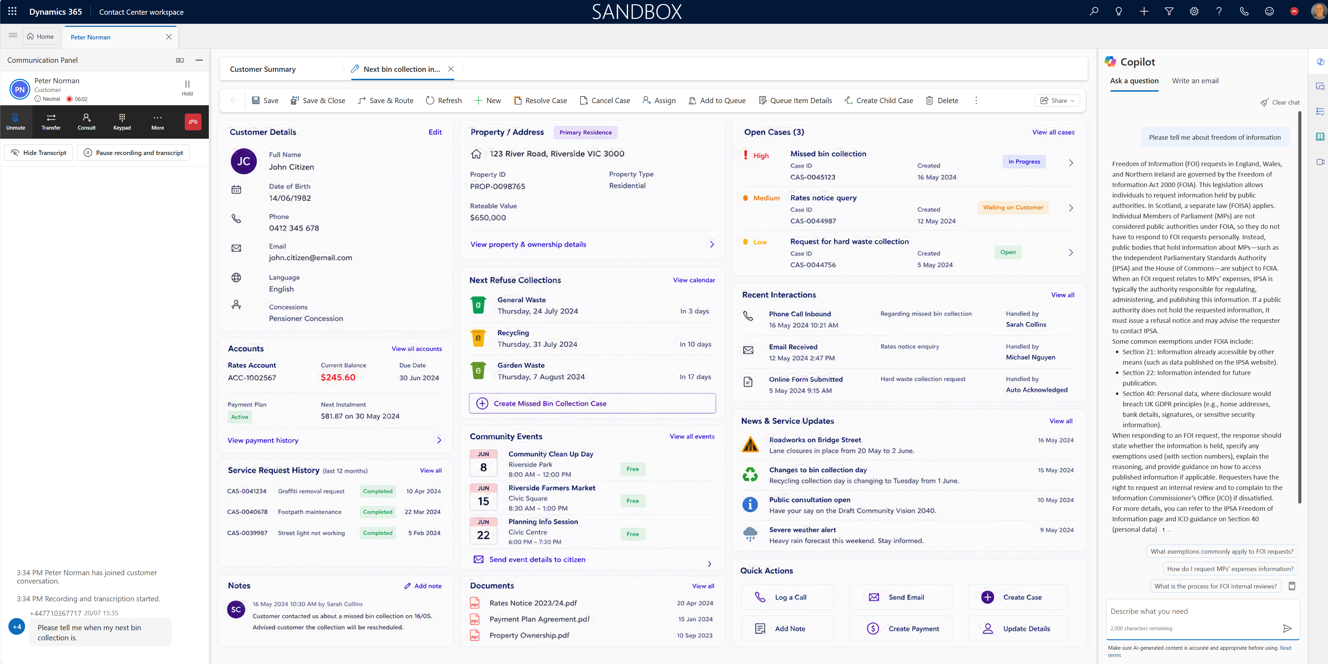
This can help employees spend less time gathering background information and more time dealing with the resident’s enquiry. The aim is to make the relevant context easier to find as part of the employee’s existing workflow, not to ask them to navigate another disconnected system.
Management has a related but different need. Data platforms such as Microsoft Fabric or Databricks can help bring together, manage and analyse information from multiple service systems. This can support a broader view of service demand, performance and patterns across the organisation, helping managers identify where processes may need attention and make better-informed decisions. The platform supports the data and analysis behind those insights; it is distinct from the frontline screen an employee uses to handle an individual interaction.
Integration alone, however, isn’t enough. Information may be stored in different formats, use inconsistent identifiers or contain gaps and inaccuracies. Local government needs to understand these issues and establish appropriate data management, matching and quality processes before relying on connected information. Access must also be governed so employees see only the information appropriate to their role and purpose.
The priority is to make existing information more useful, with a clear purpose for both frontline service delivery and management insight, rather than duplicate records or add unnecessary complexity.
Trust needs to be designed in
Bringing information together across services requires appropriate controls to ensure it is accurate, secure and used responsibly.
A 360° view should give employees access only to the information relevant to their role and the service they are delivering. Clear permissions and governance are essential, particularly when information relates to sensitive areas such as housing or social care.
Data quality also matters. Information drawn from different systems may contain gaps, inconsistencies or outdated details. Local government needs processes to maintain data quality and ensure employees can understand the context and source of the information they see.
The aim is to give frontline employees a more complete picture to support their interactions with residents, while enabling management to use connected data with confidence. Technology can make information easier to access and analyse, but employees remain responsible for applying their judgement and following the appropriate processes when using it.
Start with a service problem
It can be tempting to begin with the ambition of connecting everything across the organisation. In practice, a focused approach can help local government demonstrate value and establish the foundations for wider adoption.
Start by identifying where missing or fragmented information creates a specific problem. Where do frontline employees spend time searching for records? Which processes involve repeated requests for the same information? What would managers like to understand about demand, performance or hand-offs that is difficult to see today?
Choose a defined use case and be clear about who needs the information and why. A contact centre single view may be a useful starting point for frontline employees. In parallel, or as a later step, a data platform can bring together information for management reporting and analysis. Connect systems progressively, based on the value they provide, and establish appropriate access controls and governance from the outset.
Measure whether the change improves access to information, reduces duplication, helps employees resolve enquiries more effectively or gives managers a clearer view of service performance. These findings can then inform where to extend the approach.
The value of a 360° view isn’t measured by how much information has been brought together. It’s measured by whether frontline employees can provide a more informed response and management can use connected data to understand services and make better-informed decisions.
Helping Local Government Work Smarter
This article is part of our Helping Local Government Work Smarter series, exploring how local government can use technology, data and AI to address operational challenges, improve services and make better use of resources.
Explore the full blog series…
-
-
- 1 → Making Microsoft Copilot Count in Local Government
- 2 → Digital Front Door: Making Local Government Services Easier to Access
- 3 → Joining the Dots: Building a 360° View of the Citizen
- 4 → From Reactive to Preventative: Using Data and AI in Adult Social Care
- 5 → Reducing the Casework Burden in Local Government
- 6 → Better Complaints Handling: Using AI to Respond Faster and Learn More
- 7 → Taking the Manual Effort Out of Freedom of Information Requests
- 8 → Doing More With Less: Rethinking the Local Government Back Office
- 9 → Acting Earlier: Turning Local Government Data into Preventative Action
- 10 → Protecting Every Pound: A Data-Led Approach to Counter Fraud in Local Government
-