
Protecting Sensitive Data in AI Workflows


In the first blog in this series, we explored how organisations can express AI risk in financial terms. Across many AI use cases, one scenario consistently deserves close attention: sensitive information moving into, through or out of AI services without sufficient visibility or control.
Generative AI fundamentally changes the way information can leave an organisation. Data loss is no longer limited to an attachment, removable device or cloud upload. A user can disclose sensitive content through a prompt, a conversation, a browser-based interaction or an automated workflow. In the AI era, the data can become the prompt.
The security team’s dilemma
AI can improve productivity, accelerate research and support faster decision-making. At the same time, security teams must manage the risks of intellectual property loss, privacy breaches, regulatory non-compliance and unauthorised access. Attempting to block AI outright is rarely a sustainable answer. It can encourage workarounds and remove the visibility needed to manage risk effectively.
A better strategy is to create secure pathways for responsible AI use: approved services for legitimate business activity, clear data-handling expectations, risk-based technical controls and ongoing monitoring as new tools and use cases emerge.
Five common routes for AI data exposure
- Prompt copy and paste. Employees enter contract text, financial information, customer details, source code or internal analysis into public or unapproved tools.
- Direct file uploads. Users upload spreadsheets, repositories, presentations or strategic documents for summarisation, translation or analysis.
- Embedded AI in SaaS. Existing business applications introduce AI features that process organisational content through additional services or models.
- Over-broad enterprise assistant access. An approved assistant discovers and presents information that users can technically access but were not expected to find.
- Connected and autonomous agents. Agents interact with mailboxes, applications and databases, increasing the potential impact of excessive permissions, unsafe instructions or compromised workflows.
Five pillars of AI-ready data protection
1. Discover applications and use cases
Begin with visibility. Build an inventory of public, embedded and enterprise AI services in use across web, SaaS and endpoints. Assess each service against factors such as data handling, retention, model training, identity support, contractual terms and business purpose. Technologies including SASE, secure web gateway and CASB can contribute evidence, but discovery should also include procurement, architecture and business stakeholders.
2. Understand and classify sensitive information
Traditional keywords and labels remain useful, but AI workflows require richer context. Organisations should be able to recognise personal data, regulated records, source code, legal content, commercial strategy and other sensitive information even when it appears as an extract within a prompt. Classification should be aligned with business ownership and handling rules so that controls reflect the consequence of exposure, not simply the presence of a term.
3. Apply controls to prompts, files and responses
Controls need to operate where AI interactions occur. Depending on the use case, this could include inline inspection of prompts and uploads, restrictions on unapproved applications, tenant-level protections for approved services, monitoring of generated responses and safeguards around connectors and plug-ins. AI-aware DLP, SASE and endpoint controls can provide a consistent policy layer across several channels.
4. Coach users at the point of risk
Not every event requires a hard block. Graduated responses can protect data while preserving productivity:
- Permit approved, low-risk activity that complies with policy.
- Warn the user, explain the risk and request a business justification where the context is uncertain.
- Redact, restrict or prevent transmission when sensitive or regulated information is detected.
- Create an event for investigation when behaviour may indicate repeated policy avoidance, compromised identity or deliberate misuse.
5. Govern permissions before connecting enterprise AI
Enterprise assistants can amplify existing information-governance weaknesses. Before deployment, organisations should review broad group memberships, legacy shares, stale content, external access and inherited permissions. Identity, least privilege, data ownership and retention are therefore essential parts of AI security, not separate hygiene activities.
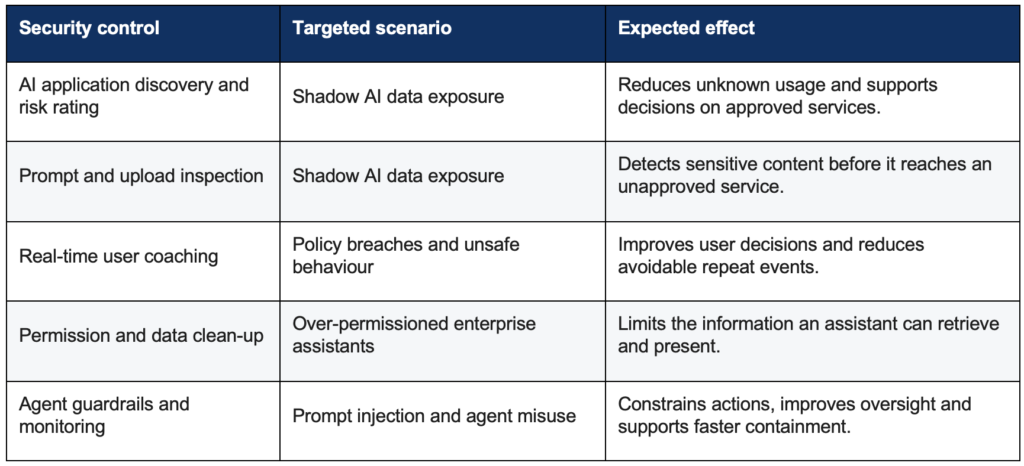
Mapping controls to risk reduction
Data protection is an operating model, not a one-off project
AI applications, models and business use cases will continue to change. Policies that are effective today may become too restrictive, too permissive or technically incomplete as services evolve. Sustainable governance therefore requires ownership, exception handling, performance measures, regular policy tuning and a feedback loop between security, data, privacy, legal and business teams.
Useful measures may include discovered AI services, approved versus unapproved usage, sensitive prompts prevented, coaching outcomes, repeat events, high-risk exceptions, permission remediation and the resulting change in quantified exposure. Reporting should distinguish activity volume from genuine risk reduction so executives can see whether controls are improving outcomes.
How Telefónica Tech supports secure AI adoption
Telefónica Tech combines advisory, cybersecurity, data and AI, cloud and managed-service capabilities to help organisations establish secure foundations for AI. Our approach can support customers through four connected stages:
- Discover AI usage, review information flows and identify material data and access risks.
- Define approved use cases, governance responsibilities and proportionate allow, coach, protect and escalate policies.
- Configure the selected security, identity, data-protection and platform controls around business priorities.
- Operate and improve. Monitor activity, investigate risk events, tune policies and provide governance reporting as the AI landscape changes.
Partner technologies such as Netskope can provide important capabilities across AI application discovery, SASE, CASB and AI-aware DLP. The technology, however, is only one part of the answer. Sustainable protection depends on connecting platform controls with governance, data ownership, user behaviour and ongoing operational oversight.
Create a safer route to AI value
The organisations that scale AI successfully will be those that make secure behaviour the easiest route for their people. That means giving users approved tools, clear guidance and controls that respond to context rather than relying on blanket restriction.
Telefónica Tech helps customers understand how data is moving through AI services, prioritise the most material risks and build an actionable roadmap for responsible adoption. The outcome is greater visibility, stronger control and a foundation for innovation that customers, employees and regulators can trust.