
Fabric Unified Admin Monitoring: Part 1
Fabric Unified Admin Monitoring Introducing FUAM: A Unified Approach to Fabric and Power BI Administration
Part 1 of 3
Introduction
Monitoring and governance are at the heart of running a healthy Microsoft Fabric and Power BI environment. As organisations grow, so does the complexity of their data landscape: multiple workspaces, numerous datasets, refresh schedules, capacity usage, and ever-changing tenant settings. Without a unified view, administrators often struggle with fragmented tools, limited data retention, and blind spots in governance. All of this has created a growing need for a centralised tool with broader capabilities than what is currently available
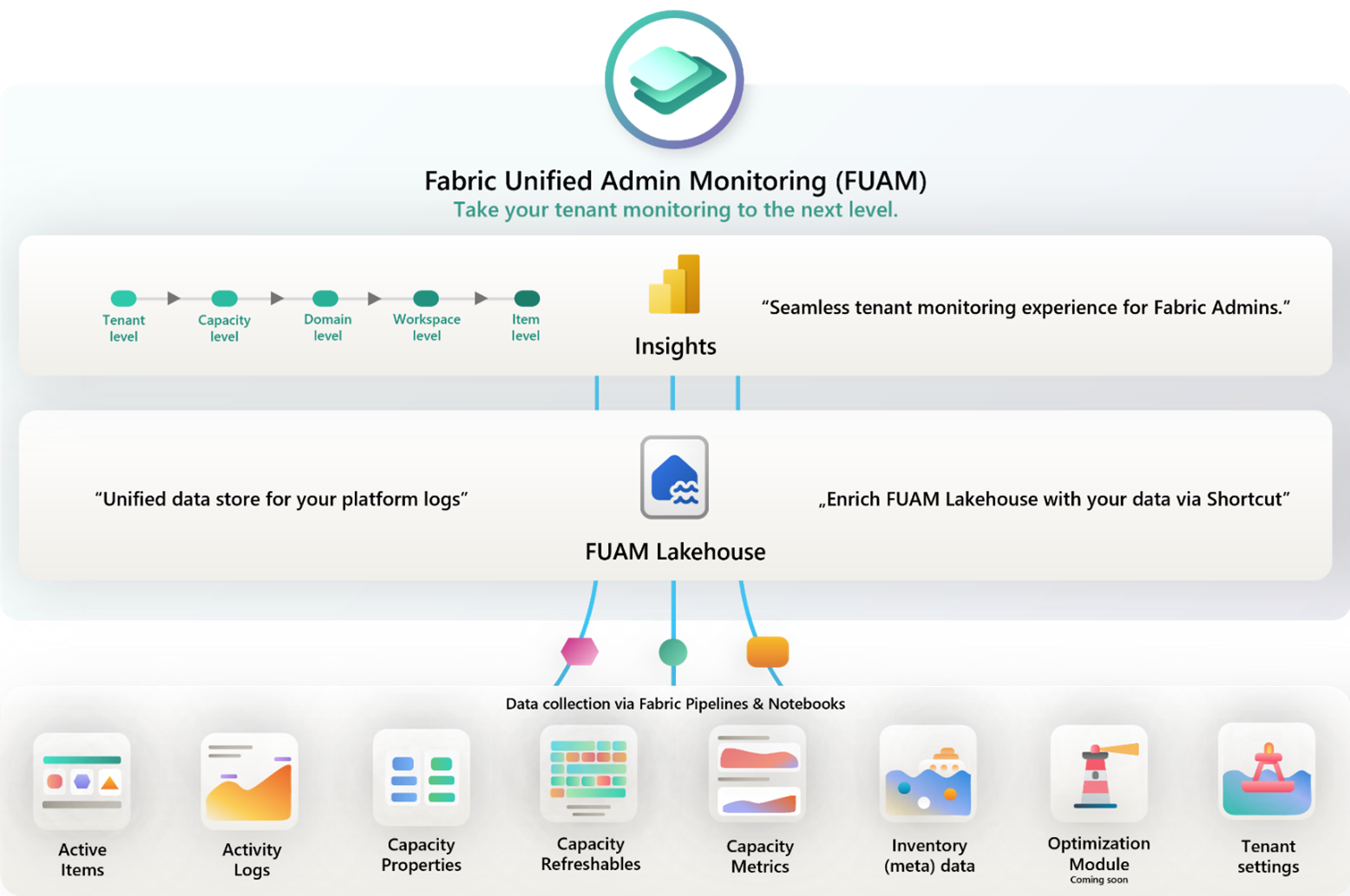
Fabric Unified Admin Monitoring (FUAM) is a community driven solution accelerator that consolidates monitoring data from across Fabric and Power BI into a single, coherent framework. Built using Fabric-native components, FUAM enables administrators to track tenant settings, user activities, workspaces, capacities, and more – all in one place. Unlike traditional monitoring apps that provide only snapshots or limited retention, FUAM stores data in lakehouses, enabling historical analysis, trend detection, and custom reporting. Whether the goal is to monitor suspicious activities, optimise capacity usage, or enforce governance policies, FUAM provides the foundation for proactive administration.
Across this three-part blog series, we’ll explore what FUAM is, who created it, how it works, its key features, limitations and why it’s becoming an essential tool for Fabric and Power BI admins.
What is FUAM?
Creators
FUAM was created by Gellért Gintli and Kevin Thomas, two Microsoft employees with deep experience in the field. Their goal was to provide administrators with a centralised, extensible solution for monitoring and governance – a tool that could overcome the limitations of the built-in dashboards and fragmented admin portals.
Released as a community driven, open-source solution on GitHub, FUAM benefits from contributions, feedback, and improvements from the wider Power BI and Fabric community. While it is developed by Microsoft staff, it is not an official Microsoft product, meaning that its evolution depends on community engagement, real-world use cases, and shared expertise.
This community driven approach offers several advantages:
- Rapid iteration – Updates and improvements can be implemented quickly based on actual user needs rather than a fixed product roadmap.
- Flexibility and customisation – Administrators can adapt FUAM to their organisation’s specific governance and monitoring requirements.
- Transparency and accessibility – Since all code is open-source, admins have direct access to the underlying architecture, making it easier to understand, audit, and extend.
- Shared knowledge and best practices – The GitHub repository acts as a hub where the community shares insights, resolves issues, and proposes enhancements, creating a collaborative ecosystem around Fabric monitoring.
In essence, FUAM reflects a blend of Microsoft expertise and community driven innovation, providing admins with a robust, adaptable, and transparent tool for managing their Fabric environments. But being a community product, it does come with some drawbacks, which we will discuss in later parts of this blog.
Below is a generalised overview of how FUAM works:
Design Principles and Capabilities
FUAM combines a robust architectural design with practical capabilities, giving users both flexibility and actionable insights:
1. Fabric–native
FUAM leverages existing Fabric components such as Lakehouses, Pipelines, Notebooks, and Power BI reports. This ensures seamless integration with your tenant without introducing external dependencies.
Transparent and auditable – All data collected by FUAM resides in your Fabric tenant. This provides full control and visibility into what is being monitored, how it is stored, and how it can be used for reporting and analysis. Every metric, log, and configuration is traceable, eliminating “black boxes”.
2. Modular and extensible
FUAM is not a monolithic solution. Its components – including lakehouses, pipelines, semantic models, and pre-built reports can be deployed selectively. Administrators can start with the default modules and expand or customise them as needed to meet the evolving needs of the business.
3. Proactive monitoring and long-term value
FUAM is designed not just for reactive oversight but for ongoing governance and optimisation. By storing monitoring data in lakehouses over time, administrators can perform historical analysis, track trends, and detect patterns that would be invisible in short-term dashboards. This ability to track history makes FUAM particularly valuable for administrative reporting, helping optimise the environment, anticipate issues, and inform strategic decisions.
4. Practical administrative capabilities
Built on these principles, FUAM provides administrators with the following benefits:
– Comprehensive tenant visibility – Track tenant settings, user activities, workspace inventories, and capacity usage in a single framework.
– Historical analysis and trend detection – Analyse trends, identify recurring issues, and detect anomalies that might otherwise go unnoticed.
– Governance and compliance enforcement – Gain insight into security settings, user privileges, and workspace configurations to enforce policies and ensure compliance.
– Proactive optimisation – Anticipate issues such as overused capacities, failing dataset refreshes, or unused workspaces, enabling intervention before problems escalate.
– Custom reporting and integration – The modular design allows admins to build their own dashboards and metrics on top of the FUAM data model, tailoring insights to organisational needs.
In essence, FUAM combines strong design principles with practical, actionable capabilities, transforming raw monitoring data into insights that help administrators manage their Fabric environment efficiently, safely, and proactively.
Curious how FUAM actually works and delivers insights? Check out Part II, where we explore its architecture, data pipelines, and pre-built reports.