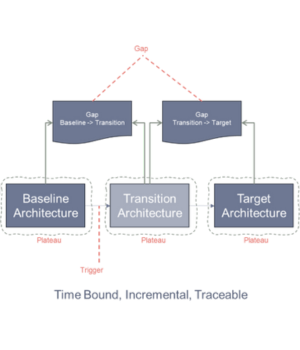
What Is Transition Architecture?

Transition architecture is a core discipline within enterprise and security architecture that defines how an organisation can move from its current (baseline) state to a desired (future) state, through a series of intermediate, clearly defined stages. It’s not a new methodology and is clearly defined as part of TOGAF (The Open Architecture Group), but it’s perhaps overlooked within security projects which are often in a state of flux. 


It acts as a strategic and operational bridge, mapping out not only the technical progression but also the dependencies, governance considerations, and organisational changes needed to deliver transformation. This becomes particularly valuable in the context of security transformations, such as evolving a Security Operations Centre (SOC), where complexity is high and the stakes are even higher.


Why It Matters in Security Architecture 


Security transformation programmes often falter for two main reasons. They are either too focused on engineering and tooling, with little connection to business strategy, or they operate in isolation from existing architecture, making it difficult to measure progress or demonstrate ROI. 


Transition architecture addresses both challenges. By creating a structured and visual model(s) of change, it helps security teams align technical delivery with organisational goals. Such clarity is crucial when dealing with legacy tooling, evolving threat landscapes, and competing pressures around cost, compliance, and capability. 

When applied to SOCs, transition architecture enables incremental change that is measurable, visible to stakeholders, and sensitive to cultural and operational realities. It can provide a means to articulate and reassure senior stakeholders on how you are maintaining or improving risk posture throughout a period of change. 


The Real-World Challenges It Tackles 


SOCs rarely start from a blank slate. Long-tenured staff may have a deep attachment to existing platforms. Inherited tech stacks complicate change, and the SOC typically spans multiple teams and processes, including business functions, IT, Service Management, DevOps, risk and compliance. 

Transformation efforts often get stuck in silos or lose momentum due to fragmented ownership, slow governance cycles, or lack of visibility. In some cases, security programmes become “side quests” disconnected from wider organisational priorities. 

Transition architecture helps to navigate these issues by visualising and communicating a sequence of achievable states. This reduces the fear of big-bang failures and creates a shared language across technical and business teams. 


What Makes Transition Architecture Effective 

An effective transition architecture rests on four key components: 


  1. Clarity on Baseline and Target States

Define the current and future states across tools, workflows, data, responsibilities, and governance. The target must reflect both security and business priorities—whether cloud-native adoption, faster response, or improved detection maturity. 


  1. Intermediate Transition Stages

Rather than jumping directly from old to new, the architecture should plot out clear intermediate stages. Each one should include specific, measurable milestones — such as decommissioning a legacy system, deploying a new capability, or mitigating a known risk. This enables a continuous sense of progress and ensures value is delivered at every phase. 


  1. Visual Dashboards and Models

Architecture visuals help to simplify complexity and make technical roadmaps easier to communicate. TOGAF-style diagrams or layered mesh models can show how people, processes, technologies and risks interconnect.  Give your stakeholders a complete picture with context. Try mapping your security project to the IT methodologies such as Cloud Adoption Frameworks (CAF). That way you are speaking a common language not trying to educate the wider organisation on your favourite security framework. 

Traffic-light dashboards are especially effective. They show what’s live, what’s in flight, and what’s still to come — allowing for quick, consistent updates that can engage technical and non-technical audiences alike. 


  1. Delivery Through Building Blocks

Breaking down the transformation into modular building blocks — such as log ingestion, alert triage, automation, or governance reviews — turns architecture into action. These blocks act as the foundation of your delivery framework and can be directly tied to project plans, improving accountability and making delivery more manageable. 

Applying Transition Architecture in SOC Programmes 


In practice, there are methodologies to aid and help solve real-world SOC challenges: 

One could utilise frameworks like NIST to derive architectural opportunities and outcomes.. By identifying key building blocks and presenting them through visual dashboards, this can help teams move from an underperforming SOC to an operational and business-aligned model. 

You can utilise maturity model such as SOC-CMM to assess people, processes, and technologies across multiple SOCs. While useful, these models require experienced facilitators to avoid subjectivity and ensure consistency in scoring. Layered with a transition architecture approach one can add an extra layer by visualising maturity improvements alongside technical and procedural changes. 

For cloud-first organisations, a different approach could be to use transition architecture security capabilities were integrated into their cloud adoption journey — applying Microsoft’s or AWS Cloud Adoption Framework and adding a security-focused track alongside infrastructure and application streams. This “SOC down the side” method allowed security to be embedded in a way that felt natural to the business. 


Lessons from the Field 


A few themes stand out across our engagements. 

First, successful architecture flexes to the language and goals of the business. Forcing a rigid security framework usually fails or loses momentum quickly. The best outcomes come from architects who can listen well, understand cultural nuance, and adapt models to fit the organisation. 

Second, visuals make a difference. In complex organisations, diagrams, dashboards and layered maps are not just nice to have — they are critical for decision-making and engagement. 

Finally, transformation happens through people. Consider cultural change not just tooling change. Engagement of those at the coal face who are potentially emotionally invested in their ways of working and tooling is vital. Experienced security architects who can balance strategy and delivery, communicate across silos, and navigate internal politics are the true drivers of successful change. 


The Broader Benefits 


When done well, transition architecture can reduce risk, simplify delivery, and improve alignment across business and security teams. It enables a phased, measured approach rather than a disruptive overhaul. It shows and can demonstrate ROI at every stage. This approach helps stakeholders feel part of the journey, not just subject to it. 

Such a structured approach to change is especially important in the security space, where the stakes are high and the environment is constantly shifting. 

In Summary 

Transition architecture is not just about diagrams or frameworks. It is about creating clarity in complexity. It enables organisations to move confidently from where they are to where they need to be, one clear step at a time. 

For SOC transformations, it provides the structure, language and visibility needed to turn good intentions into tangible outcomes. By aligning strategy with delivery, and people with process, security transformation becomes not only successful, but sustainable.