
Modern Data Centre Networking: Principles That Work in Practice


Modern Data Centre Networking: Principles That Work in Practice
Why the technology was rarely the actual problem.
Introduction
The traditional data centre is far from obsolete. Many organisations still rely on architectures that have delivered stable services for years.
The challenge is that the environment around those architectures has changed.
Networks originally designed around predictable traffic patterns now support applications that may span data centres, public cloud platforms and SaaS services. Workloads move more often. Security teams are expected to understand activity that no longer follows obvious boundaries, and the path between an application and its dependencies is not always easy to see.
That leaves many organisations facing a practical question: how do we modernise without making the environment harder to operate?
It is tempting to respond by refreshing hardware, increasing bandwidth or adding another security control. Those investments may help, but only when they support a coherent architecture and operating model. In practice, the harder problems are often visibility, consistency, ownership and the ability to make changes safely.
After working across enterprise, service-provider and multi-tenant environments, one observation has stayed with me: the real difficulty is rarely a lack of technology. More often it sits in inconsistent design decisions, incomplete visibility, unclear ownership or operational processes that have not kept pace with the platform.
Products and features matter, of course. But architecture is what determines whether those capabilities work together in a way people can actually support.
1. Why established designs come under strain
Legacy architectures were built to solve the problems of their time, and many have served organisations well for years. Pressure tends to appear when the environment grows, application patterns change, or operational processes do not evolve with the technology.
Manual operations become harder to manage
Configuration exceptions tend to accumulate over time. A temporary change becomes permanent, a workaround is never revisited, or the documentation simply falls behind what is running.
A single change may be straightforward. Repeated changes across a larger estate are where drift starts to appear. Two devices that were intended to be identical can behave differently because of an old exception that nobody had reason to revisit.
That may be manageable in a small environment. At larger scale, it can increase troubleshooting time, change risk and reliance on individual knowledge.
Visibility becomes more important
A recurring troubleshooting challenge is understanding application dependencies. A team may know that an application requires database access, but not whether it also relies on authentication, monitoring, third-party services or a legacy component that sits outside the expected path.
Without enough visibility, diagnosis becomes a process of elimination. The network may show that packets are moving, but that does not necessarily confirm that the complete service is working as users expect.
Security policy can become tied to location
Traditional security policies are often expressed through IP addresses, network segments or zones. These controls remain useful, but maintaining them can become difficult when workloads migrate, containers are rebuilt, or applications expand across different environments.
Where practical, policy should reflect workload identity, application function and required communication as well as network location. The right balance depends on the platform, risk profile and operational maturity of the organisation.
Infrastructure delivery can lag behind application delivery
In some organisations, a virtual workload can be created quickly while the associated network and security changes take considerably longer. That mismatch can delay delivery and encourage workarounds. It is usually a sign that provisioning, approval and policy processes need to be considered together rather than optimised in isolation.
2. Principles that support modern data centre architecture
There is no single architecture that suits every organisation. Scale, regulation, investment history, team capability and application requirements all matter. Even so, several principles are useful across a wide range of environments.
Keep the physical network predictable
For many larger data centres, a routed leaf-spine fabric can provide predictable paths and a practical way to scale. Smaller or less dynamic environments may not require the same model. The broader principle is to keep the underlay stable, well understood and straightforward to troubleshoot.
Overlay technologies can add useful flexibility, but they also add another layer to operate. When an incident occurs, engineers still need a clear way to separate an underlay problem from an overlay or policy problem.
Decouple workloads from unnecessary physical boundaries
Overlay and virtual networking technologies can allow logical networks to be delivered independently of the physical topology. This can help multi-tenant providers separate customer environments and help enterprises isolate business units, development platforms and production services without extending large Layer 2 domains unnecessarily.
None of this is complexity for its own sake. The payoff is being able to place workloads where they need to run, with the right connectivity and separation in place.
Express policy in terms of intent
Where the platform supports it, policy can describe the communication that is required rather than relying only on device-by-device configuration. For example:
- application services may communicate with their approved database services.
- management access may be limited to authorised administration paths; and
- development workloads may be separated from production services.
The implementation will vary, but the purpose is consistent: make policy easier to understand, review and apply with less variation.
Use automation where it reduces risk
Automation is useful when it makes repeatable work more consistent and auditable. Infrastructure-as-code, configuration management and controlled delivery pipelines can all help, provided that the underlying process is understood first.
A rule I find useful is this: if a team performs the same well-defined change repeatedly, it is worth asking whether that change can be automated. Automation still needs engineering judgment behind it, and it shouldn’t turn the environment into a black box. The aim is to remove avoidable variation and give engineers more time for the work that is less predictable.
Design for the wider service environment
The data centre is now one part of a broader service landscape. Applications may depend on private infrastructure, cloud platforms, SaaS services, branch locations and remote users. Connectivity, monitoring and security therefore need to be considered across the complete service path, not only inside one building.
3. A practical reference model
The model below brings these principles together: a practical way to connect infrastructure decisions with service and operational outcomes, rather than a prescriptive architecture.
Article content
A practical operating model linking network foundations, policy, services and operational outcomes.
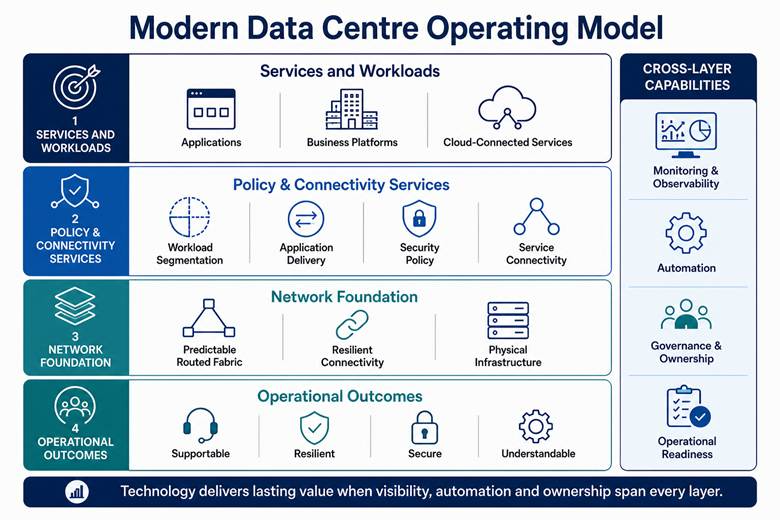
A practical design might combine a resilient routed fabric with logical segmentation, layered security controls, application delivery services and repeatable deployment processes. That is a reference point, not a universal blueprint.
The detail should follow application requirements and operational capability. Perimeter inspection may still be important, but internal segmentation and workload-level controls can also be appropriate. Load balancing, name resolution, certificate handling, monitoring and logging should be treated as service dependencies rather than late additions.
Real environments also contain constraints that diagrams tend to hide:
- legacy or unsupported applications;
- dependencies that are only partly documented;
- platforms introduced through acquisition;
- temporary solutions that became long-term services; and
- different teams operating at different levels of maturity.
A workable architecture recognises those realities. It creates a route toward standardisation without assuming that every exception can be removed immediately. Clear principles are often more durable than a design built around the features of a particular product.
4. Lessons that deserve early attention
Microsegmentation needs governance
Microsegmentation can reduce unnecessary communication and limit the potential impact of a compromise. The challenge is that enforcement is only as good as the understanding behind it.
I have seen programmes discover important dependencies only after restrictive policies were introduced. The control behaved as configured; the application knowledge was incomplete. Visibility, service ownership, documented exceptions and a safe change process should therefore develop alongside the policy model.
The underlay still matters
Problems in the underlay do not always announce themselves as underlay problems. Inconsistent routing, unreliable links or poor convergence often surface as confusing issues higher up the stack.
When troubleshooting a complex fabric, one of the most useful questions remains a simple one: is the underlying network behaving as designed?
Security decisions should not be left until migration
Decisions about inspection, address translation, encryption boundaries and east-west controls can affect application behaviour, performance and the migration sequence. They are easier to manage when discussed during design rather than introduced as late-stage conditions.
Application owners need a place in the design
Infrastructure teams can produce a technically sound design and still miss an application assumption. In my experience, some of the most useful design discussions happen with the people who understand how the service behaves during normal operation, maintenance and failure.
Not every application preference can become a network requirement, obviously. What matters is getting the dependencies and trade-offs on the table early, before they turn into migration problems or operational surprises.
5. Questions worth asking during a design review
Rather than starting every discussion with a technology choice, I find these questions more useful. They are prompts, not fixed rules:
- Is the physical and routed foundation simple enough to operate under pressure?
- Where is workload-based segmentation useful, and where would it add more complexity than value?
- Are security controls placed at meaningful service boundaries?
- Can repeated changes be automated without hiding how they work?
- Does the design account for cloud, SaaS, branches and remote access where relevant?
- Are monitoring, logging and dependency visibility in place before migration?
- Who owns policy decisions, exceptions and lifecycle changes?
- Have application and operations teams tested the assumptions behind the design?
- Will the resulting service be understandable and supportable after the project team leaves?
Conclusion
A bigger, faster network or the newest platform isn’t really the goal. The real goal is an environment that can change without becoming harder to understand or support.
The technology available today is capable. Products alone, though, do not create a sustainable operating model. Architecture, security, automation and operations need to reinforce one another. Otherwise, advanced platforms can end up compensating for unclear ownership, inconsistent policy or limited visibility.
The more sustainable environments I have encountered tend to get the fundamentals right. They simplify where they can. They automate work that is genuinely repeatable, involve the people who understand the applications, and treat operational readiness as part of the design rather than the final handover task.
The implementation will differ from one organisation to another. The practical test is whether the service is secure enough for its risk, resilient enough for its purpose, and something people can actually operate when conditions are less than ideal.
Technology will keep changing. Good engineering principles usually last longer.
Which architectural principle or design decision has made the biggest positive difference in your environment?